Category: Practicals

  • Assay of Dapsone

    Aim

    To determine the percentage purity of a given sample of the tablet.

    Principle

    Dapsone is a diamino diphenyl sulphone. It is assayed by direct diazotization titration. The free primary amino group present in dapsone is
    diazotized by nitrous acid and hydrochloric acid to form an arene diazonium compound. The endpoint can be determined by using an external indicator i.e. starch iodide paper, during titration with sodium nitrite an aromatic primary amine is diazotized. After the endpoint, the drug solution containing a slight excess of nitrite comes in contact with starch iodide paper. It oxidizes iodide into iodine which gives blue colour with starch indicating the endpoint.

    Reaction

    Procedure

    Preparation of 0.1M Sodium nitrite solution

    7.5g of sodium nitrite was dissolved insufficient water to be produced 1000ml.

    Standardisation of 0.1M Sodium nitrite

    0.3g of sulphanilic acid was dissolved in 50ml of 2M hydrochloric acid, 3g of potassium bromide was added, cool in ice and titrate with 0.1M sodium nitrite solution using starch iodide paper as an external indicator.
    Each ml of 0.1M Sodium nitrite= 0.01732g of C6H7NO3S.

    Assay of Dapsone tablet

    20 tablets were weighed and powdered. Tablet powder equivalent to0.25gm dapsone was weighed and dissolved in a mixture of 15ml of 2M
    hydrochloric acid. The solution was cooled to about 15oC and carry out sodium nitrite titration using starch iodide paper as an external indicator. The endpoint is the immediate appearance of blue colour.
    Each ml of 0.1M sodium nitrite= 0.01241g of C12H12N2O2S.

    Report

    The Molarity of 0.1M sodium nitrite = __________________
    The percentage purity of given dapsone tablet was found to be = ________________

  • Assay of Metronidazole

    Aim

    To determine the percentage purity of a given sample of Metronidazole tablet.

    Principle

    A substance with very weak acid or basic property does not give a sharp endpoint in an aqueous solution can be titrated with non-aqueous solvents. Non-aqueous titration is based on Bronsted-Lowry theory According to this theory an acid is a proton donor, i.e. a substance which tends to dissociate to yield a proton and a base is a proton acceptor, i.e. a substance which tends to combine with a proton. When an acid HB dissociates it yields a proton together with the conjugate base B of the acid.
    Metronidazole is a weak base and it is assayed by non-aqueous titration. When a weakly basic drug is dissolved in an acidic solvent with titration of
    perchloric acid, the basic property of a mineral is enhanced. If a strong acid like perchloric acid is added to acetic acid, the acetic acid behaves as a base and combine with a proton donated by perchloric acid to form an onium ion which acts as a strong acid, the onium ion has readily donated the proton to the base. The indicator used in this titration is crystal violet. The use of acetic anhydride in this solution combines with the water molecule to form acetic acid.

    Reaction

    Procedure

    Preparation of Perchloric acid 0.1M

    Mixed 8.5 ml of Perchloric acid in 900 ml of glacial acetic acid shake vigorously and continuous stirring. Then added 30 ml acetic anhydride and
    make up the volume to 1 litre with glacial acetic acid and allowed to stand for 24 hours before use. The acetic anhydride reacts with the water in perchloric acid and some traces in glacial acetic acid thereby making the resulting mixture practically anhydrous.

    Standardisation of 0.1 N Perchloric acid

    About 0.5g of Potassium hydrogen phthalate were weighed accurately and transfer in a 100 ml conical flask, previously dried at 120oC for 2 hours.
    50ml of glacial acetic acid was added, warmed if necessary, to dissolve the salt completely. Cooled and titrated with 0.1M perchloric acid using crystal violet 0.1ml (2 drops) as an indicator. The endpoint is colour changes from violet to emerald green.
    Each ml of 0.1M Perchloric acid = 0.02042g of Potassium Hydrogen Phthalate

    Assay of metronidazole

    About 3.0g of metronidazole sample was weighed accurately and transfer into a 250ml conical flask, 50ml of Glacial acetic acid was added, warmed
    gently. Cooled and titrated with 0.1M perchloric acid using α-Naphthol benzene as an indicator. The endpoint is colour changes from Blue to Blue-green.

    Each ml of 0.1M perchloric acid = 0.02042g of Potassium hydrogen Phthalate.

    Report

    The Molarity of 0.1M Perchloric acid = _____________
    The Percentage purity of given metronidazole was found to be = ________________

  • Assay of Isonicotinic Acid Hydrazide

    Aim

    To determine the percentage purity of a given sample of Isonicotinic acid hydrazide tablet.

    Principle

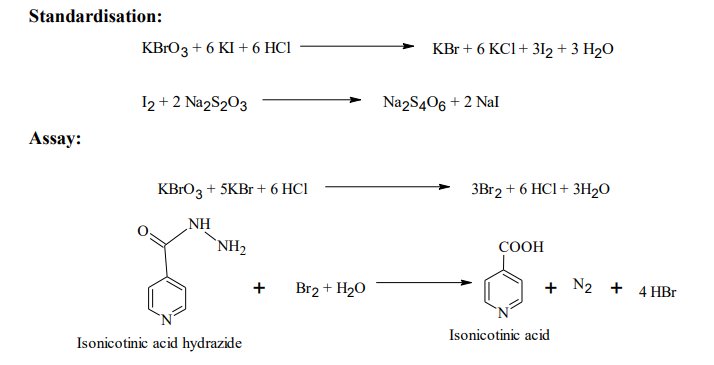
    Isonicotinic acid hydrazide/ isoniazid is an anti-tubercular drug. It is assayed by the direct titration of Potassium bromate with the addition of potassium bromide in the presence of acid medium using hydrochloric acid. During oxidation reaction liberated bromine reacts with isoniazid in an aqueous solution to form isonicotinic acid. Azo dye methyl red indicator is used in this titration, decolourized the red colour is the end point.

    Reaction

    Procedure

    Preparation of 0.0167 M Potassium bromate solution

    About 5.566gm of Potassium bromate was dissolved in water and made up to 1000 ml with distilled water.

    Standardisation of 0.0167 M Potassium bromate

    20 ml of the above solution was transferred in a glass stopper flask and 3 g of Potassium iodide and followed with 3 ml of HCl was added. Allow standing for 5 min, titrate liberated Iodine with 0.1 M sodium thiosulphate adding 3 ml of starch solution TS and the endpoint is approached.

    The concentration of 0.0167 M Potassium bromate = (Molarity of Sodium thiosulphate)/(Volume of Potassium bromate)

    Assay of Isonicotinic acid hydrazide tablet

    Twenty tablets were weighed accurately and pulverized. A weighed quantity of the tablet power equivalent to 0.25 mg INH was transferred into a
    clean and dry 100 ml volumetric flask, then sufficient water was added to produce 100 ml. 20 ml of the above solution was taken. Then 100 ml of water, 20 ml of hydrochloric acid and 0.2 gm of Potassium bromide were added. Then titrated slowly with continuous shaking with 0.0167M potassium bromate using 0.05ml of methyl red as an indicator until the red colour disappears.
    Each ml of 0.0167M Potassium bromate KBrO3 = 0.003439g of C6H7N3O.

    Report

    The Molarity of 0.1 M Sodium nitrite
    The percentage purity of the given isonicotinic acid Hydrazide tablet was found to be: ______________________

  • Synthesis of Hexamine

    Aim

    To prepare and submit hexamine from formaldehyde and calculate its Percentage Yield.

    Principle

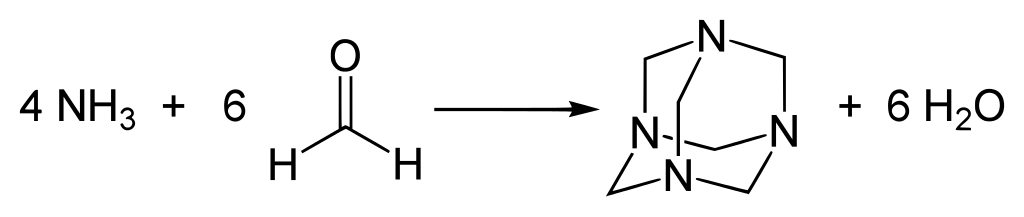
    Hexamine is a heterocyclic organic compound (CH2)6N4. It has a symmetrical tetrahedral cage-like structure. It is prepared by a condensation
    reaction between formaldehyde and ammonia.

    Reaction

    Requirements

    • Formaldehyde – 4.7 g
    • Ammonia Solution – 7 g

    Procedure

    About 4.7g of 30% formaldehyde solution was taken in a beaker and add 7g of 24% ammonia solution was until the solution is slightly alkaline. The mixture was heated on a water bath for 5 minutes and allowed to stand for 15 minutes. The solution was filtered and then evaporated on a direct flame using a china dish to a thick paste. The hexamine crystals are obtained and dried. It was recrystallized from water or alcohol. Hexamine forms colourless, odourless crystals, which are soluble in water and 90% alcohol.
    Use: Urinary anti-infective agent

    Report

    Hexamine was prepared and submitted. Report the following
    Theoretical Yield:
    Practical Yield:
    Percentage Yield:

  • Synthesis of Tolbutamide

    Aim

    To prepare and submit tolbutamide from p-toluene sulfonamide and calculate its percentage yield.

    Principle

    The synthesis of tolbutamide involves the addition reaction of p-toluene sulfonamide and butyl isocyanate in the presence of triethylamine and
    tetrahydrofuran.

    Reaction

    Requirements

    • p-Toluene Sulfonamide – 1 g
    • Butyl isocyanate – 1 g
    • Triethylamine – 1.2 ml
    • Tetrahydrofuran – 10 ml

    Procedure

    About N-butyl isocyanate (1mmol) and triethylamine (1.2mmol) in a round bottom flask containing 10 ml of tetrahydrofuran, kept in an ice bath. To the above mixture p-toluene sulfonamide (1mmol) was added dropwise at 0oc. After completing the addition, the temperature was suddenly raised to 35-45oC and stirred for 3-4 Hrs. Then the solution was filtered. The product was separated and dried. Then it was recrystallised by using Diethyl ether.
    Melting Point: 128oC to 129oC
    Use: Anti-diabetic

    Report

    Tolbutamide was Prepared and submitted. Report the Following
    Theoretical Yield:
    Practical Yield:
    Percentage Yield:

  • Synthesis of Chlorbutanol

    Aim

    To Prepare and submit chlorobutanol from acetone and calculate the Percentage Yield.

    Principle

    Chlorbutanol is also known as Chloroketone. It is a trichloro derivative of tertiary butyl alcohol. It is prepared by combination with acetone and
    chloroform in the presence of solid potassium hydroxide Chlorobutanol is used as a local anaesthetic in dental preparation and also antiseptic.

    Reaction

    Requirements

    • Chloroform – 11 ml
    • Potassium hydroxide – 1 gm
    • Acetone – 14 ml

    Procedure

    About 11 ml of chloroform and 1 gm of solid potassium hydroxide are taken in a round bottom flask shake until the potassium hydroxide dissolves. To this 14 ml of acetone was added and shaken for 15 minutes. Then set aside for half an hour and the crystal of chlorobutanol were separated out.
    Melting Point: 95oC – 99oC

    Use: Local anaesthetics

    Report

    Chlorbutanol was Prepared and submitted and reported the following

    1. Theoretical Yield =
    2. Practical Yield =
    3. Percentage yield =
  • Synthesis of 7- Hydroxy -4- Methyl Coumarin

    Aim

    To Synthesis and submit Synthesis of 7- Hydroxy -4- methyl coumarin.

    Principle

    A general synthesis of coumarins involves the interaction of a phenol with a β- ketoester in presence of an acid condensing agent (Pechmann
    reaction). Concentrated sulphuric acid is usually used as the condensing agent for simple monohydric phenols and β- ketoesters, although phenol itself reacts better in the presence of aluminium chloride. The mechanism of the reaction involves the initial formation of a β- hydroxy ester, which then cycles and dehydrates to yield the coumarin. Polyhydric phenols, particularly here the two hydroxy groups are meta oriented, react with great ease and sulphuric acid is used as the condensing agent with careful temperature control to ensure a good yield.

    Reaction

    Requirements

    • Conc. Sulphuric acid -7.5 ml
    • Resorcinol – 1.2 g
    • Ethylacetoacetate – 2.4 ml
    • Ice – q.s
    • Sodium Hydroxide – q.s
    • Ethanol – q.s

    Procedure

    Take 1 litre of concentrated sulphuric acid in 3 litres capacity 3 necked flask fitted with a thermometer, mechanical stirrer and a dropping funnel. Immerse the flask in an ice bath. When the temperature falls below 100C, add a solution of 100 g (0.91 mol) of resorcinol in 134 g (130.5 ml, 1.03 mol) of redistilled ethyl acetoacetate dropwise and with stirring. Maintain the temperature below 100C by means of an ice bath during the addition (2h). Keep the mixture at room temperature for 18 hr and then pour it into a mixture of 2 kg of crushed ice with vigours stirring and add 3 litres of water. Collect the precipitate by suction filtration and wash it with three 25 ml portions of cold water. Dissolve the solid in 1500 ml of 5 per cent sodium hydroxide solution, filter and add dilute 2 M sulphuric acid (about 550 ml) with vigorous stirring until the solution is acid to litmus. Filter the crude 4-methyl-7-hydroxy coumarin at the pump, wash with four 25 ml portions of cold water and dry at 1000C. The yield is 155g (97%). Recrystallise from 95 per cent ethanol: the pure compound separate in colourless needles, m.p. 1850C.

    Use

    • Laser dye.
    • Starting material for production of the insecticide ‘ hymecromone’.

    Report

    7- hydroxy -4- methyl coumarin was synthesized and the percentage yield was found to be …….. %.

  • Synthesis of Sulphanilamide

    Aim

    To synthesis and submit sulphanilamide from p-acetamido benzene sulphanilamide and calculate its percentage yield.

    Principle

    Sulphanilamide can be prepared by the reaction of P-acetamido benzene sulphanilamide with Hydrochloric acid or ammonium carbonate. The acetamido groups are easily undergoing acid catalysed hydrolysis reaction to form p-amino benzene sulphonamide.

    Reaction

    Requirements

    • Resorcinol – 1.2 g
    • Ethyl acetoacetate – 2.4 ml
    • Conc. Sulphuric acid – 7.5 ml

    Procedure

    1.5 gm of 4- acetamido benzene sulphonamide is treated with a mixture of 1 ml of conc. Sulphuric acid was diluted with 2 ml water. This mixture is gently heated under reflux for 1 hour. Then 3ml of water is added and the solution is boiled again, with the addition of a small quantity of activated charcoal. The solution is filtered while hot, and the filtrate is neutralised with powdered sodium carbonate with stirring until all effervescence ceases and the sulphanilamide is precipitated as a white powder. The solution is cooled, filtered, the sulphanilamide washes with water and dried. Finally, crude sulphanilamide is recrystallized from hot water, to get colourless crystals.

    Melting Point: 1630C

    Category: Bacteriostatic agent

    Report

    The Sulphanilamide was synthesised and submitted, Reported the following

    1. Theoretical Yield =
    2. Practical Yield =
    3. Percentage Yield =
  • Study Of Local Anaesthetic Property By Foot Withdrawal Method

    Aim: To study the local anaesthetic property of procaine HCL using nerve block anaesthesia by
    frog foot withdrawal method.

    Principle: Local anaesthetics reversibly block impulse conduction along nerve axons and excitable membranes. Their action is used to produce local or regional anaesthesia and for blocking pain sensation. the local anaesthetic property can be easily studied by using

    • Nerve block anaesthesia
    • Surface anaesthesia
    • Infiltration anaesthesia

    Requirements:

    Animal: Frog
    Drugs: Procaine HCL (1%w/v)
    Equipment: Frog board surgical instruments

    Procedure:

    1. Decereb the frog and Place the frog (100-150 gm) and destroy the upper part of the spinal
      cord with the help of pithing needle.
    2. Cut open the abdomen and remove all the abdominal organs , so that a pouch is made of
      abdominal walls.
    3. Expose the spinal nerves in the cavity
    4. Put the frog on the frog board with two of its hind legs hanging free from the board.
      Alternatively the frog may be pinned to the board placed vertically so that its hind legs
      hang free
    5. Immense the right hind leg in the beaker containing 0.1N HCL.
    6. Note the brisk reflex withdraw of the leg
    7. Wash the immerse leg with flowing water or normal saline.
    8. Repeat the same with the left hind leg.
    9. Wash the immersed left.
    10. Place about 10 ml of 1% w/v procaine Hcl in the abdominal pouch. The sciatic nerve flex is exposed to the local anaesthetic actions of the drugs. allow the drug to act for 5 min.
  • Study Of Anxiolytic Of Drugs Using Mice/rat

    Aim: To study the anxiolytic activity of diazepam in mice using elevated zero mazes.

    Principle: The elevated zero maze test is a behavioural test of anxiety based on the naturalistic
    the tendency of rodents to avoid open and elevated areas. It is similar to the more widely used elevated plus maze, except that the open and closed arms are arranged circularly, thus eliminating the centre area which removes ambiguity in the interpretation of time spent in the central square of the traditional design. The maze is an elevated, white or black, annual having an outer diameter of 45 cm and an inner diameter of 30 cm. The runway ring where the mouse can explore 6cm width, which is divided into 4 quadrants, 2 opposing “open” quadrants without walls and 2 opposing closed quadrants. The model is widely used for the elevation of anxiolytic agents belonging to a chemically different class of drugs.

    Requirements:
    Animal: Mice (20-25gm)
    Drugs: Diazepam (dose 2 mg/kg. i.p)
    Equipment: Zero mazes with the dimension

    Procedure:

    1. Weigh and number the animals . divide them into two groups each consisting of
      minimum 6 mice. One group is used as control and other drugs treatment.
    2. Place the animal individually in the open arm facing towards the closed arm. Start the
      stop watch and note the following parameters for a period of six minutes.
      • Latency to enter the open arm
      • Average time each animals spends in the open arm
      • Total number of entries in the open arm
      • Stretching into open quadrants
    3. Clean the maze thoroughly using tissue paper after each trail.
    4. Inject diazepam to the test group. After 30 min place the animals individually as described.