Category: Medicinal Chemistry

  • Synthesis of Aspirin Assisted by Microwave Oven

    Aim

    To Prepare and Submit aspirin from Salicylic acid and Calculate the Percentage Yield.

    Principle

    The microwave region of Electro-Magnetic spectrum light between IR irradiation and frequency corresponding to the wavelength of 1cm-1 to 1m. The organic compound can be heated by applying energy in the form of microwave high-frequency IR irradiation. The use of this technique can have substantial saving time for laboratory synthesis of drugs and chemicals.
    Aspirin is prepared from Salicylic acid, in this method salicylic acid reacts with acetic anhydride in the presence of sulphuric acid to form the crystalline nature of aspirin.

    Reaction

    Procedure

    Two reactions consist of a two-neck flask with a magnetic stir bar, temperature, sensor and intensive cooler. A mixture of salicylic acid and acetic
    anhydride is filled in the reaction flask and three drops of conc. Sulphuric Acid is added the apparatus is installed by means of a glass tube in the microwave system. Standard refluxing apparatus for microwave system. The reaction mixture is heated under stirring for 90 sec. with 900 W to 140 C, during the following cooling down the clear yellowish solidified to a compact white crystalline mass
    Melting Point: 1350C
    Use: Anti-inflammatory agent

    Result

    Aspirin was synthesised and reported the following

    1. Theoretical yield =
    2. Practical yield =
    3. Percentage yield =
  • Synthesis of Phenytoin from Benzil by Microwave Irradiation

    Aim

    To synthesis and submit phenytoin from benzil by using a microwave oven and calculate its percentage yield.

    Principle

    The microwave region of Electro-Magnetic spectrum light between IR irradiation and frequency corresponding to the wavelength of 1cm-1
    to 1m. The organic compound can be heated by applying energy in the form of microwave high-frequency IR irradiation. The use of this technique can have substantial saving time for laboratory synthesis of drugs and chemicals. Phenytoin is prepared by condensation of benzil and urea under reflux condensation to give the heterocyclic compound Pinnacol. When the pinnacle is treated with sodium hydroxide it’s rearrangement to produce phenytoin as sodium salt and the esterification gives phenytoin as a crude product. This reaction is completed to take place only 2 to 3 minutes of microwave irradiation.

    Reaction

    Requirements

    • Benzil = 1.25g
    • Urea = 0.75g
    • NaOH (30%)= 3.75 ml
    • Methanol = 18.75 ml

    Procedure

    1.25gm of benzil, 0.75gm urea, 3.75ml 30% sodium hydroxide and 18.75 ml methanol was taken in a beaker and kept in a Microwave oven for 3 minutes. Then it was cooled to room temperature and 50ml of water was poured, mixed well and filtered. To the filtrate con. HCl was added to get the crude product. Then the product was recrystallized from ethanol.

    Melting Point: 295oC to 298oC
    Use: Anti-convulsant

    Report

    Phenytoin was synthesised and reported the following

    1. Theoretical yield =
    2. Practical yield =
    3. Percentage yield =
  • Assay of Benzyl Penicillin

    Aim

    To determine the percentage purity of a given sample of Benzylpenicillin tablet.

    Principle

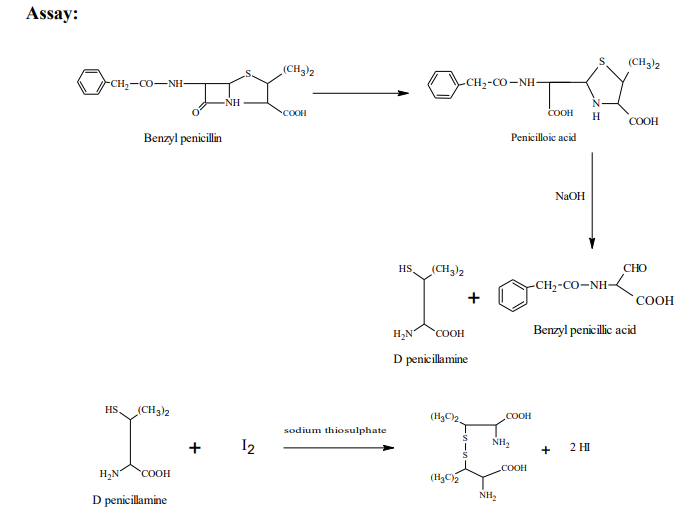
    Benzylpenicillin is assayed by the iodometric titration method. The titration is in which an equivalent amount of iodine is liberated to form potassium iodide by the sample and the liberated iodine is titrated against standard sodium thiosulphate solution. This type of indirect titration determination of compounds is called iodometric titration. In this titration, benzylpenicillin is first hydrolysed with sodium hydroxide solution converted to corresponding penicilloic acid (dicarboxylic acid). Then penicilloic acid is further treated with a mineral acid to form D-Penicillamine and benzyl penicillic acid. An obtained D-penicillamine is further oxidized quantitatively iodine to give disulphide, excess of iodine is
    back titrated with 0.02M sodium thiosulphate, an equivalent amount of liberated iodine can be measured by titration with sodium thiosulphate using starch as an indicator, which is added near the endpoint as it get hydrolysed by hydrochloric acid and iodine gets trapped in the matrix of starch. Due to this, there is no continuous liberation of iodine. An endpoint is blue to apple green.

    Reaction

    Procedure

    Preparation of 0.02N Sodium thiosulphate

    0.02N sodium thiosulphate (4.564 gm of sodium thiosulphate and 250 mg of sodium carbonate) dissolved in 100 ml of water then makeup to 1000ml with water.

    Standardization of 0.02N sodium thiosulphate

    Dissolved accurately weighed 0.2g of potassium bromate in 250ml of water taken in a conical flask. From this take 50 ml of the solution, add 2g of potassium iodide, 3ml of 2M HCl and titrate with sodium thiosulphate solution using starch as an indicator until the blue colour is discharged.
    Each ml of 0.01N sodium thiosulphate= 0.002784g of KBr.

    Assay of Benzyl penicillin

    Weighed accurately about 0.1gm of the sodium salt of benzylpenicillin taken in a stoppered flask, dissolved in 10ml of water and dilute to 100ml. 10ml of the solution was transferred into an iodine flask, 5ml of 1N sodium hydroxide was added, allowed to stand for 20 minutes. Then freshly prepared buffer solution, 5ml of 1N hydrochloric acid and 25ml of excess of 0.02N iodine solution was added to the stoppered flask and kept aside for 20 minutes in a dark place. Excess iodine is titrated with 0.02N sodium thiosulphate using freshly prepared starch solution as an indicator. The endpoint is the discolouration of blue colour. To another 10ml of the initial solution add 20ml of the buffer solution,
    allowed to stand for 20 minutes in the dark place and titrate with the same. The difference between the two titrations represents the volume of 0.02N iodine equivalent to the total amount of penicillin present in the given sample of benzylpenicillin.

    Report

    The molarity of 0.01M sodium thiosulphate = __________________
    The percentage purity of given Benzyl penicillin tablet was found to be = __________________

  • Assay of Chlorpheniramine Maleate

    Aim

    To determine the percentage purity of a given sample of Chlorpheniramine malate.

    Principle

    Chlorpheniramine maleate has chemically known as 3-(4-chlorophenyl) N, N- Dimethyl-3-(2-pyridyl) propylamine hydrogen maleate is an antihistamine H1 receptor antagonist. Mineral acid salts of weak nitrogen bases hydrolyse so extensively in the aqueous or hydro-alcoholic solution that is possible to titrate the liberated acid with a strong mineral base. Titration of the maleate salt of the drug in the water against the sodium hydroxide leads to the formation of water turbidity as the titration proceeds. To prevent this precipitation, alcohol has been used. Since alcohol is basic with respect to water as a solvent, dissolved bases react less strongly alkaline, their salts react more strongly acid, and the endpoints of the titrations are greatly sharpened, here an aqueous solution of Chlorpheniramine maleate was titrated with aqueous NaOH, the turbidity was formed with the appearance of pink as the endpoint.

    Reaction

    Procedure

    Preparation of 0.01M Sodium hydroxide

    Weighed accurately about 0.4gm of Sodium hydroxide pellet in a clean 1000ml standard flask then completely dissolved with 100ml distilled water, and makeup to 1000 ml with distilled water.

    Standardisation of 0.01M sodium hydroxide

    Weighed accurately about 0.5gm of potassium hydrogen phthalate and transferred it into a 1000ml conical flask. Then add 75ml of distilled water to dissolve and titrated with 0.01M sodium hydroxide solution using 0.1ml phenolphthalein as an indicator. The end point is the appearance of permanent pale pink colour.
    Each ml of 0.01M Sodium hydroxide= 0.002042g of C8H5KO4

    Assay of Chlorpheniramine maleate

    Twenty tablets were weighed and grind into a fine powder. An amount of power equivalent to 200mg of chlorpheniramine maleate was weighed
    accurately into a 100ml standard flask, 70ml of neutral alcohol was added and shaken for about 20 min. Then, the volume was made up to mark with neutral alcohol, mixed well and filtered using Whatman No 42 filter paper. The first 10 ml portion of the filtrate was discarded. An aliquot of the drug solution containing 2.0-20.0 mg of chlorpheniramine maleate was measured accurately and transferred into a clean 100 ml conical flask and the total volume was brought to 10 ml with a neutral alcohol. Then 2 drops of 0.5% phenolphthalein indicator were added and the solution was titrated with standard 0.01M Sodium hydroxide solution until a permanent pink colour was obtained.
    Each ml of 0.01M Sodium hydroxide= 0.002042g of C8H5KO4.

    Report

    The molarity of 0.01M Sodium hydroxide = ___________________
    The percentage purity of given Chlorpheniramine maleate tablet was found to be = ____________________

  • Assay of Dapsone

    Aim

    To determine the percentage purity of a given sample of the tablet.

    Principle

    Dapsone is a diamino diphenyl sulphone. It is assayed by direct diazotization titration. The free primary amino group present in dapsone is
    diazotized by nitrous acid and hydrochloric acid to form an arene diazonium compound. The endpoint can be determined by using an external indicator i.e. starch iodide paper, during titration with sodium nitrite an aromatic primary amine is diazotized. After the endpoint, the drug solution containing a slight excess of nitrite comes in contact with starch iodide paper. It oxidizes iodide into iodine which gives blue colour with starch indicating the endpoint.

    Reaction

    Procedure

    Preparation of 0.1M Sodium nitrite solution

    7.5g of sodium nitrite was dissolved insufficient water to be produced 1000ml.

    Standardisation of 0.1M Sodium nitrite

    0.3g of sulphanilic acid was dissolved in 50ml of 2M hydrochloric acid, 3g of potassium bromide was added, cool in ice and titrate with 0.1M sodium nitrite solution using starch iodide paper as an external indicator.
    Each ml of 0.1M Sodium nitrite= 0.01732g of C6H7NO3S.

    Assay of Dapsone tablet

    20 tablets were weighed and powdered. Tablet powder equivalent to0.25gm dapsone was weighed and dissolved in a mixture of 15ml of 2M
    hydrochloric acid. The solution was cooled to about 15oC and carry out sodium nitrite titration using starch iodide paper as an external indicator. The endpoint is the immediate appearance of blue colour.
    Each ml of 0.1M sodium nitrite= 0.01241g of C12H12N2O2S.

    Report

    The Molarity of 0.1M sodium nitrite = __________________
    The percentage purity of given dapsone tablet was found to be = ________________

  • Assay of Metronidazole

    Aim

    To determine the percentage purity of a given sample of Metronidazole tablet.

    Principle

    A substance with very weak acid or basic property does not give a sharp endpoint in an aqueous solution can be titrated with non-aqueous solvents. Non-aqueous titration is based on Bronsted-Lowry theory According to this theory an acid is a proton donor, i.e. a substance which tends to dissociate to yield a proton and a base is a proton acceptor, i.e. a substance which tends to combine with a proton. When an acid HB dissociates it yields a proton together with the conjugate base B of the acid.
    Metronidazole is a weak base and it is assayed by non-aqueous titration. When a weakly basic drug is dissolved in an acidic solvent with titration of
    perchloric acid, the basic property of a mineral is enhanced. If a strong acid like perchloric acid is added to acetic acid, the acetic acid behaves as a base and combine with a proton donated by perchloric acid to form an onium ion which acts as a strong acid, the onium ion has readily donated the proton to the base. The indicator used in this titration is crystal violet. The use of acetic anhydride in this solution combines with the water molecule to form acetic acid.

    Reaction

    Procedure

    Preparation of Perchloric acid 0.1M

    Mixed 8.5 ml of Perchloric acid in 900 ml of glacial acetic acid shake vigorously and continuous stirring. Then added 30 ml acetic anhydride and
    make up the volume to 1 litre with glacial acetic acid and allowed to stand for 24 hours before use. The acetic anhydride reacts with the water in perchloric acid and some traces in glacial acetic acid thereby making the resulting mixture practically anhydrous.

    Standardisation of 0.1 N Perchloric acid

    About 0.5g of Potassium hydrogen phthalate were weighed accurately and transfer in a 100 ml conical flask, previously dried at 120oC for 2 hours.
    50ml of glacial acetic acid was added, warmed if necessary, to dissolve the salt completely. Cooled and titrated with 0.1M perchloric acid using crystal violet 0.1ml (2 drops) as an indicator. The endpoint is colour changes from violet to emerald green.
    Each ml of 0.1M Perchloric acid = 0.02042g of Potassium Hydrogen Phthalate

    Assay of metronidazole

    About 3.0g of metronidazole sample was weighed accurately and transfer into a 250ml conical flask, 50ml of Glacial acetic acid was added, warmed
    gently. Cooled and titrated with 0.1M perchloric acid using α-Naphthol benzene as an indicator. The endpoint is colour changes from Blue to Blue-green.

    Each ml of 0.1M perchloric acid = 0.02042g of Potassium hydrogen Phthalate.

    Report

    The Molarity of 0.1M Perchloric acid = _____________
    The Percentage purity of given metronidazole was found to be = ________________

  • Assay of Isonicotinic Acid Hydrazide

    Aim

    To determine the percentage purity of a given sample of Isonicotinic acid hydrazide tablet.

    Principle

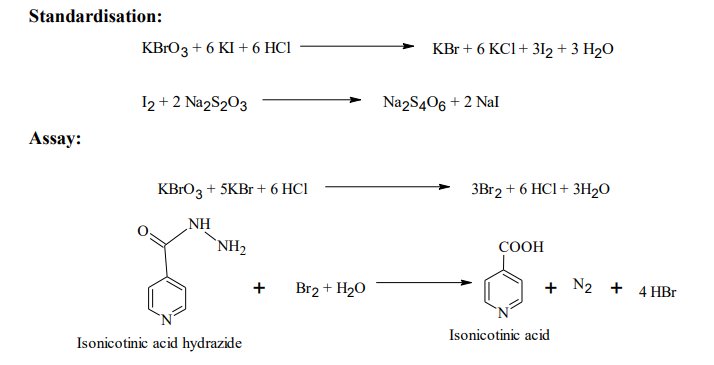
    Isonicotinic acid hydrazide/ isoniazid is an anti-tubercular drug. It is assayed by the direct titration of Potassium bromate with the addition of potassium bromide in the presence of acid medium using hydrochloric acid. During oxidation reaction liberated bromine reacts with isoniazid in an aqueous solution to form isonicotinic acid. Azo dye methyl red indicator is used in this titration, decolourized the red colour is the end point.

    Reaction

    Procedure

    Preparation of 0.0167 M Potassium bromate solution

    About 5.566gm of Potassium bromate was dissolved in water and made up to 1000 ml with distilled water.

    Standardisation of 0.0167 M Potassium bromate

    20 ml of the above solution was transferred in a glass stopper flask and 3 g of Potassium iodide and followed with 3 ml of HCl was added. Allow standing for 5 min, titrate liberated Iodine with 0.1 M sodium thiosulphate adding 3 ml of starch solution TS and the endpoint is approached.

    The concentration of 0.0167 M Potassium bromate = (Molarity of Sodium thiosulphate)/(Volume of Potassium bromate)

    Assay of Isonicotinic acid hydrazide tablet

    Twenty tablets were weighed accurately and pulverized. A weighed quantity of the tablet power equivalent to 0.25 mg INH was transferred into a
    clean and dry 100 ml volumetric flask, then sufficient water was added to produce 100 ml. 20 ml of the above solution was taken. Then 100 ml of water, 20 ml of hydrochloric acid and 0.2 gm of Potassium bromide were added. Then titrated slowly with continuous shaking with 0.0167M potassium bromate using 0.05ml of methyl red as an indicator until the red colour disappears.
    Each ml of 0.0167M Potassium bromate KBrO3 = 0.003439g of C6H7N3O.

    Report

    The Molarity of 0.1 M Sodium nitrite
    The percentage purity of the given isonicotinic acid Hydrazide tablet was found to be: ______________________

  • Synthesis of Hexamine

    Aim

    To prepare and submit hexamine from formaldehyde and calculate its Percentage Yield.

    Principle

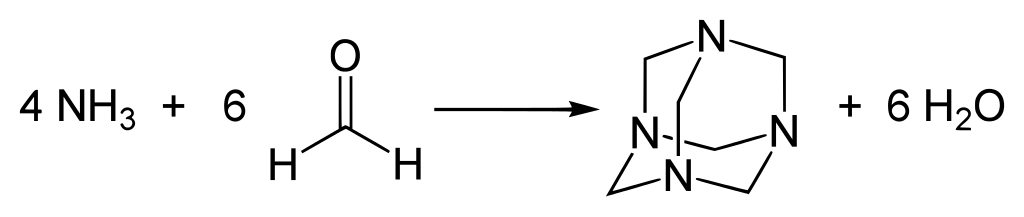
    Hexamine is a heterocyclic organic compound (CH2)6N4. It has a symmetrical tetrahedral cage-like structure. It is prepared by a condensation
    reaction between formaldehyde and ammonia.

    Reaction

    Requirements

    • Formaldehyde – 4.7 g
    • Ammonia Solution – 7 g

    Procedure

    About 4.7g of 30% formaldehyde solution was taken in a beaker and add 7g of 24% ammonia solution was until the solution is slightly alkaline. The mixture was heated on a water bath for 5 minutes and allowed to stand for 15 minutes. The solution was filtered and then evaporated on a direct flame using a china dish to a thick paste. The hexamine crystals are obtained and dried. It was recrystallized from water or alcohol. Hexamine forms colourless, odourless crystals, which are soluble in water and 90% alcohol.
    Use: Urinary anti-infective agent

    Report

    Hexamine was prepared and submitted. Report the following
    Theoretical Yield:
    Practical Yield:
    Percentage Yield:

  • Synthesis of Tolbutamide

    Aim

    To prepare and submit tolbutamide from p-toluene sulfonamide and calculate its percentage yield.

    Principle

    The synthesis of tolbutamide involves the addition reaction of p-toluene sulfonamide and butyl isocyanate in the presence of triethylamine and
    tetrahydrofuran.

    Reaction

    Requirements

    • p-Toluene Sulfonamide – 1 g
    • Butyl isocyanate – 1 g
    • Triethylamine – 1.2 ml
    • Tetrahydrofuran – 10 ml

    Procedure

    About N-butyl isocyanate (1mmol) and triethylamine (1.2mmol) in a round bottom flask containing 10 ml of tetrahydrofuran, kept in an ice bath. To the above mixture p-toluene sulfonamide (1mmol) was added dropwise at 0oc. After completing the addition, the temperature was suddenly raised to 35-45oC and stirred for 3-4 Hrs. Then the solution was filtered. The product was separated and dried. Then it was recrystallised by using Diethyl ether.
    Melting Point: 128oC to 129oC
    Use: Anti-diabetic

    Report

    Tolbutamide was Prepared and submitted. Report the Following
    Theoretical Yield:
    Practical Yield:
    Percentage Yield:

  • Synthesis of Chlorbutanol

    Aim

    To Prepare and submit chlorobutanol from acetone and calculate the Percentage Yield.

    Principle

    Chlorbutanol is also known as Chloroketone. It is a trichloro derivative of tertiary butyl alcohol. It is prepared by combination with acetone and
    chloroform in the presence of solid potassium hydroxide Chlorobutanol is used as a local anaesthetic in dental preparation and also antiseptic.

    Reaction

    Requirements

    • Chloroform – 11 ml
    • Potassium hydroxide – 1 gm
    • Acetone – 14 ml

    Procedure

    About 11 ml of chloroform and 1 gm of solid potassium hydroxide are taken in a round bottom flask shake until the potassium hydroxide dissolves. To this 14 ml of acetone was added and shaken for 15 minutes. Then set aside for half an hour and the crystal of chlorobutanol were separated out.
    Melting Point: 95oC – 99oC

    Use: Local anaesthetics

    Report

    Chlorbutanol was Prepared and submitted and reported the following

    1. Theoretical Yield =
    2. Practical Yield =
    3. Percentage yield =