Category: Medicinal Chemistry

  • Synthesis of 7- Hydroxy -4- Methyl Coumarin

    Aim

    To Synthesis and submit Synthesis of 7- Hydroxy -4- methyl coumarin.

    Principle

    A general synthesis of coumarins involves the interaction of a phenol with a β- ketoester in presence of an acid condensing agent (Pechmann
    reaction). Concentrated sulphuric acid is usually used as the condensing agent for simple monohydric phenols and β- ketoesters, although phenol itself reacts better in the presence of aluminium chloride. The mechanism of the reaction involves the initial formation of a β- hydroxy ester, which then cycles and dehydrates to yield the coumarin. Polyhydric phenols, particularly here the two hydroxy groups are meta oriented, react with great ease and sulphuric acid is used as the condensing agent with careful temperature control to ensure a good yield.

    Reaction

    Requirements

    • Conc. Sulphuric acid -7.5 ml
    • Resorcinol – 1.2 g
    • Ethylacetoacetate – 2.4 ml
    • Ice – q.s
    • Sodium Hydroxide – q.s
    • Ethanol – q.s

    Procedure

    Take 1 litre of concentrated sulphuric acid in 3 litres capacity 3 necked flask fitted with a thermometer, mechanical stirrer and a dropping funnel. Immerse the flask in an ice bath. When the temperature falls below 100C, add a solution of 100 g (0.91 mol) of resorcinol in 134 g (130.5 ml, 1.03 mol) of redistilled ethyl acetoacetate dropwise and with stirring. Maintain the temperature below 100C by means of an ice bath during the addition (2h). Keep the mixture at room temperature for 18 hr and then pour it into a mixture of 2 kg of crushed ice with vigours stirring and add 3 litres of water. Collect the precipitate by suction filtration and wash it with three 25 ml portions of cold water. Dissolve the solid in 1500 ml of 5 per cent sodium hydroxide solution, filter and add dilute 2 M sulphuric acid (about 550 ml) with vigorous stirring until the solution is acid to litmus. Filter the crude 4-methyl-7-hydroxy coumarin at the pump, wash with four 25 ml portions of cold water and dry at 1000C. The yield is 155g (97%). Recrystallise from 95 per cent ethanol: the pure compound separate in colourless needles, m.p. 1850C.

    Use

    • Laser dye.
    • Starting material for production of the insecticide ‘ hymecromone’.

    Report

    7- hydroxy -4- methyl coumarin was synthesized and the percentage yield was found to be …….. %.

  • Synthesis of Sulphanilamide

    Aim

    To synthesis and submit sulphanilamide from p-acetamido benzene sulphanilamide and calculate its percentage yield.

    Principle

    Sulphanilamide can be prepared by the reaction of P-acetamido benzene sulphanilamide with Hydrochloric acid or ammonium carbonate. The acetamido groups are easily undergoing acid catalysed hydrolysis reaction to form p-amino benzene sulphonamide.

    Reaction

    Requirements

    • Resorcinol – 1.2 g
    • Ethyl acetoacetate – 2.4 ml
    • Conc. Sulphuric acid – 7.5 ml

    Procedure

    1.5 gm of 4- acetamido benzene sulphonamide is treated with a mixture of 1 ml of conc. Sulphuric acid was diluted with 2 ml water. This mixture is gently heated under reflux for 1 hour. Then 3ml of water is added and the solution is boiled again, with the addition of a small quantity of activated charcoal. The solution is filtered while hot, and the filtrate is neutralised with powdered sodium carbonate with stirring until all effervescence ceases and the sulphanilamide is precipitated as a white powder. The solution is cooled, filtered, the sulphanilamide washes with water and dried. Finally, crude sulphanilamide is recrystallized from hot water, to get colourless crystals.

    Melting Point: 1630C

    Category: Bacteriostatic agent

    Report

    The Sulphanilamide was synthesised and submitted, Reported the following

    1. Theoretical Yield =
    2. Practical Yield =
    3. Percentage Yield =
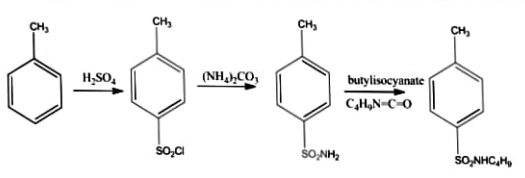
  • Synthesis of Tolbutamide

    Aim: To prepare and submit Tolbutamide from Toluene


    Reference: Jayaveera K.N., Subramanyam S., Reddy K.Y., Practical Medicinal Chemistry: S.Chand Publication; 2018, Vol. 53; Page no 397


    Chemicals Required: Concentratic Sulphuric acid, Toluene, Phosphorus pentachloride, Iodine Lime water, Sodium Carbonate, Ethyle chloroformate, Ammonium carbonate, Anhydrous potassium Carbonate, Acetic acid, dry acetone, Butyl amine, Butylisocynate


    Apparatus Required: RBE, Condenser, Beaker, Funnel, and Glass rod

    Principles: Tolbutamide, NP-methylbenezenesuphonyl)-N-butyl urea is an oral hyperglycemic
    agent used for the treatment of non-insulin-dependent diabetes mellitus (NIDDM). It is structurally similar to acetohexamide, chlorpropamide, and tolazamide and belongs to the sulphonylurea class
    of insulin secretagogues which act by stimulating the beta cells of the pancreas to release insulin.
    Sulphonylureas increase both basal insulin secretion and metal stimulated insulin release

    Synthesis of Tolbutamide
    Synthesis of Tolbutamide

    Procedure:

    Procedure for synthesis of p-toluenesulphonyl chloride from toluene

    • Heat 130 gm of pure toluene and 450 gm conc. sulphuric acid in a cast- iron pot fitted with suitable agitator. Add few crystals of iodine and allow the temperature to rise 100c.
    • The sulphonation is complete in about 6 hrs, transfer the reaction mixture in a large beaker diluted with water. Add lime water gradually neutralize the excess acid.
    • Filter out the calcium sulfate and any ferric hydroxide and wash with hot water.
    • Add sodium carbonate to the filtrate until just alkaline to phenolphthalein and remove the calcium carbonate by filtration. Evaporate the filtrate almost to dryness, when sodium salt of o toluene Sulphonyl and p-toluene sulphonyl acids separate out. When the reaction is complete add cold water. The p-toluene sulphonyl chloride separates as a solid and recrystallizes with alcohol. The O-toluene sulphonyl chloride is an oily liquid and is separated from the filtrate by means of a separating funnel.

    Procedure for synthesis of p-toluene sulphonamide

    • Thoroughly mix 5 grams of p-1oluene sulphonyl chloride and 10 grams of ammonium carbonate by grinding in a mortar until a fine powder is obtained.
    • Heat the mixture on a water bath with continuous stirring to convert sulphonyl chloride into sulphonamide. Crystallize the product from hot water. Filter off as colourless crystals.

    Procedure for the synthesis of ethyl p-toluene sulphonyl carbamate

    • Mix the corresponding sulphonamide 49 grams with ethyl chloroformate 42 grams and anhydrous potassium carbonate 3 grams in dry acetone 400 ml and reflux for 20 hours. Remove acetone by distillation under reduced pressure and keep the solution overnight and then add in water 250 ml. Neutralize with acetic acid. Filter the solid product and wash with distilled water and recrystallize with alcohol.

    Procedure for synthesis of tolbutamide

    • Dissolve the specified carbamate derivative in hot toluene 30 ml. Add butylamine slowly and reflux for 4 hours. Filter and dry it.

    Report: Tolbutamide was prepared and submitted.

    Uses: Tolbutamide is used together with diet and exercise to improve blood sugar control in adults
    with type 2 diabetes mellitus. Tolbutamide is not for treating type I diabetes.

  • Synthesis of Hexamine

    Aim: To prepare and submit Hexamine

    Chemicals Required: Distill Water, Formaldehyde, Conc: NH3 or NH4OH, Diethyl ether and ethyl alcohol.

    Apparatus Required: Rotary Vapouriser, Thermometer, Litmus Paper, Measuring Cylinder, Reflux Condenser, Round Bottom Flask, Beaker, Buchner Funnel, Water Bath, Vaccum Desiccator and Glass Rod.

    Principle: Hexamine is a heterocyclic organic compound that is also known as Methenamine or Hexamethylenetetramine or Urotropin. Hexamine use as an anti-infective agent and used to treat Urinary Tract Infections. Hexamethylenetetramine is prepared by the condensation of formaldehyde and ammonia

    Synthesis of Hexamine
    Synthesis of Hexamine

    Procedure: The procedure of preparing hexamine is given below:

    1. Place of 10ml of 37% formaldehyde and 9ml of ammonia into a round bottom flask.
    2. Evaporate the solution on a Rotavapor.
    3. During evaporation, a white residue (urotropin) is formed.
    4. Add another portion of Ammonia 14ml to dissolve the solid.
    5. Once more place the flask onto a Rotavapor and evaporate the solvent. Repeat the solvent. Repeat that step once more with an additional portion of ammonia(14ml).
    6. After evaporation add 15ml of anhydrous ethanol and dissolve the solid by heating under reflux.
    7. Filter the hot mixture on the Bichner Funnel.
    8. Add 10ml diethyl ethar to the filtrate and cool down.
    9. Filter the precipitated urotropin wash it with anhydrous ethanol drain well and then dry on air.

    Report: Hexamine was prepared and submitted.

    Uses of Hexamine: Uses of Hexamine is discussed below:

    • Hexamine dominantly used in the preparation of powdery and liquid preparation of phenolic resin moulding compounds.
    • Hexamine is also used as a food preservatives.
    • Hexamine is also use against concomitant odour and excessive sweating.