Category: MCQ

  • Cycloalkanes MCQ with Answers | Pharmaceutical Organic Chemistry 2

    Cycloalkanes MCQ with Answers of Pharmaceutical Organic Chemistry 2 B.Pharm 3rd Semester. All the Multiple Choice Questions and Answers share in this post are extremely helpful from an exam perspective so read and learn them all.

    Cycloalkanes MCQ with Answers | Pharmaceutical Organic Chemistry 2
    Cycloalkanes MCQ with Answers | Pharmaceutical Organic Chemistry 2

    Cycloalkanes MCQ with Answers | Pharmaceutical Organic Chemistry 2 | B.Pharm 3rd Semester

    1.Cyclopropane is synthesised from

    • 2 moles of ethyl chloride
    • 1,3-Dichloropropane
    • Calcium adipate
    • Diethyl adipate

    Ans: 1,3-Dichloropropane

    2. Cyclopropane on oxidation with conc H2SO4 gives

    • Isopropyl alcohol
    • n-Propyl alcohol
    • Butanol
    • Epoxide

    Ans: n-Propyl alcohol

    3. Cyclopropane on reduction with conc with Ni/H2 at 80 °C gives

    • Ethane
    • Butane
    • Propane
    • Pentane

    Ans: Propane

    4. Cyclopropane on halogenation with Cl2/FeCl3 gives

    • 1,1-Dichloropropane
    • 1,2-Dichloropropane
    • 1,3-Dichloropropane
    • 1,2,3-Trichloropropane

    Ans: 1,3-Dichloropropane

    5. According to Baeyer strain theory, Heat of combustion of the cycloalkanes

    • Increases as the ring size increases
    • Decreases as the ring size increases
    • No change in Heat of combustion
    • None of the above

    Ans: Decreases as the ring size increases

    6. According to Baeyer strain theory, which of the following cycloalkane is stable

    • Cyclopropane
    • Cyclobutane
    • Cyclopentane
    • Cyclohexane

    Ans: Cyclopentane

    7. According to Baeyer strain theory, which of the following conformer of cycloalkane is
    more stable

    • Chair form
    • Boat form
    • Twist-chair form
    • Twist-boat form

    Ans: Chair form

    8. According to Baeyer strain theory, which of the following statement is TRUE

    • Lesser potential energy in Chair form compare to other conformers
    • Larger potential energy in Chair form than boat form
    • Larger potential energy in twist-boat form than boat form
    • Both chair and boat form have similar potential energy

    Ans: Lesser potential energy in Chair form compare to other conformers

    9. Cycloalkanes are associated with the general formula

    • CnH2n+2
    • CnH2(n+2)
    • CnH2n+1-r
    • CnH2(n+1-r)

    Ans: CnH2(n+1-r)

    10. Identify the incorrect statement regarding cycloalkanes

    • These have sp3 hybridized carbons
    • These have tetrahedral bond angles
    • Stability of the cycloalkanes varies directly with their respective size
    • These undergo nucleophilic substitution reactions

    Ans: These have tetrahedral bond angles

    11. Identify the compound with the highest ring strain

    • Cyclohexane
    • Cyclopropane
    • Cyclobutane
    • Cyclopentane

    Ans: Cyclopropane

    12. Which among the following compounds explodes on contact with oxygen

    • Cyclopropane
    • Cyclobutane
    • Cyclopentane
    • Cyclohexane

    Ans: Cyclopropane

    13. Identify the alicyclic hydrocarbon which is highly flammable

    • Cycloheptane
    • Cyclopentane
    • Cyclopropane
    • Cyclooctane


    14. Identify the incorrect statement regarding cyclohexane:

    • It is non-polar
    • It serves as an organic solvent
    • It a hydrophilic hydrocarbon
    • It is commercially used for variety of applications

    Ans: It is a hydrophilic hydrocarbon

    15. Cycloalkanes have the same molecular formula as

    • Alkanes
    • Alkenes
    • Akynes
    • Cycloalkenes

    Ans: Alkenes

    16. Which of the following cycloalkane is most reactive?

    • Cyclohexane
    • Cyclopropane
    • Cyclobutane
    • Cyclopentane

    Ans: Cyclopropane

    17. Which of the following molecules will decolourise bromine in carbon tetrachloride
    most readily?

    • 1,2-Dimethylcyclopropane
    • 1,2-Dimethylcyclobutane
    • Cylcopentane
    • Cyclohexane

    Ans: 1,2-Dimethylcyclopropane

    18. Cyclobutane reacts with hydrogen in the presence of nickel catalyst at 200 °C to give

    • Butane
    • 1-Butene
    • 2-Butene
    • None of these

    Ans: Butane

    19. The bond angle between carbon atoms in cyclohexane is

    • 109° 28′
    • 60°
    • 90°
    • 120°

    Ans: 109° 28′

    20. The bond angle between carbon atoms in cyclopropane is

    • 109° 28′
    • 60°
    • 90
    • 120

    Ans: 60

    21. The bond angle between carbon atoms in cyclobutane is

    • 109° 28′
    • 60°
    • 90°
    • 120°

    Ans: 90°

    22. The most stable conformation of cyclohexane is the

    • Haworth form
    • Boat form
    • Chair form
    • Newman form

    Ans: Chair form

    23. Which of the following statement is false about cyclohexane?

    • It is a saturated cyclic hydrocarbon
    • All C-C-C bond angles are 109° 28′
    • Unstable, strained compound
    • Exist in chair-form and boat-form

    Ans: Unstable, strained compound

    24. Gammexane is

    • Hexachloroethane
    • DDT
    • Hexachlorocyclohexane
    • TNT

    Ans: Hexachlorocyclohexane

    25. Which of the following correctly ranks the cycloalkanes in order of increasing ring strain per methylene?

    • cyclopropane < cyclobutane < cyclohexane < cycloheptane
    • cyclohexane < cyclopentane < cyclobutane < cyclopropane
    • cyclopentane < cyclobutane < cyclopentane < cyclopropane
    • cyclopentane < cyclopropane < cyclobutane < cyclohexane

    Ans: cyclohexane < cyclopentane < cyclobutane < cyclopropane

    26. Which of the following has two equatorial alkyl substituents in its most stable conformation?

    • 1,1-dimethylcyclohexane
    • cis-1,2-dimethylcyclohexane
    • cis-1,3-diethylcyclohexane
    • cis-1,4-diethylcyclohexane

    Ans: cis-1,3-diethylcyclohexane

    27. Which of the following cycloalkanes is most reactive?

    • Cyclopropane
    • Cyclohexane
    • Cyclobutane
    • Cycloheptane

    Ans: Cyclopropane

    Disclaimer

    The content of mypharmaguide.com is provided for information and educational purposes only. We are not the owner of any PDF Material/Books/Notes/Articles published on this website. No claim is made as to the accuracy or authenticity of the PDF Material/Books/Notes/Articles of the website. In no event will this site or owner be liable for the accuracy of the information contained on this website or its use. mypharmaguide.com provides freely available PDF Material/Books/Notes/Articles on the Internet or other resources like Links etc. This site does not take any responsibility and legal obligations due to the illegal use and abuse of any information published on the website. No responsibility is taken for any information that may appear on any linked websites.

    Conclusion

    If you also want to submit your notes to help students you can contact us for submitting your notes. To contact us click here. If you find this post ” Cycloalkanes MCQ with Answers | Pharmaceutical Organic Chemistry 2 “ helpful then share it with your friends also.

    Download our android app MyPharmaGuide


  • Polynuclear Hydrocarbons MCQ with Answer | Pharmaceutical Organic Chemistry 2

    Polynuclear Hydrocarbons MCQ with Answer of Pharmaceutical Organic Chemistry 2 B.Pharm 3rd Semester. All the Multiple Choice Questions and Answers share in this post are extremely helpful from an exam perspective so read and learn them all.

    Polynuclear Hydrocarbons MCQ with Answer
    Polynuclear Hydrocarbons MCQ with Answer

    Polynuclear Hydrocarbons MCQ with Answer | Pharmaceutical Organic Chemistry 2 | B.Pharm 3rd Semester

    1.Naphthalene undergoes oxidation with Na2Cr2O7/H2SO4 to form

    • Phthalic acid
    • Benzoic acid
    • Teraline
    • Phenyl acetic acid

    Ans: Phthalic acid

    2. Naphthalene undergoes nitration with HNO3/H2SO4 at 60 °C to give mainly

    • 1-Nitronapthalene
    • 1,2-Nitronapthalene
    • 2-Nitronapthalene
    • 2,5-Nitronapthalene

    Ans: 1-Nitronapthalene

    3. Which of the following is starting material in Haworth’s synthesis of naphthalene

    • succininc anhydride
    • Phthalic anhydride
    • acetic anhydride
    • None of the above

    Ans: succininc anhydride

    4. Which of the following statement is TRUE in electrophilic aromatic substitution of
    naphthalene

    • α-Product forms
    • β-product forms
    • Both α & β product forms
    • α product always predominates depending on the condition

    Ans: α product always predominates depending on the condition

    5. Nitration of naphthalene molecule at room temperature gives

    • 1-nitronaphthalene
    • 2-nitronaphthalene
    • 4-nitronaphthalene
    • 8-nitronaphthalene

    Ans: 1-nitronaphthalene

    6. Naphthalene on oxidation with CrO3/CH3COOH gives

    • 1,2-Naphthoquinone
    • 1,3-Naphthoquinone
    • 1,4-Naphthoquinone
    • No reaction

    Ans: 1,4-Naphthoquinone

    You May Like Also

    Benzene and Its Derivatives MCQs

    Aromatic Acides MCQ

    7. Naphthalene on oxidation with V2O5 gives

    • Succinic anhydride
    • Phthalic anhydride
    • Acetic anhydride
    • No reaction

    Ans: Phthalic anhydride

    8. β-Napthalenediazonium chloride converted to naphthalene in the presence of

    • H3PO2
    • CuBr
    • CuCN
    • HCl

    Ans: H3PO2

    9. All carbon atoms in naphthalene are

    • Sp hybridised
    • sp2 hybridised
    • sp3 hybidised
    • None of the above

    Ans: sp2 hybridised

    10. Anthracene on bromination in the presence of Br2/CCl4 gives

    • 9-Bromoanthracene
    • 1-Bromoanthracene
    • 2-Bromoanthracene
    • 4-Bromoanthracene

    Ans: 1-Bromoanthracene

    11. Anthracene on sulphonation in presence of Con H2SO4 at high temperature gives

    • 1-Anthracenesulfonic acid
    • 2-Anthracenesulfonic acid
    • 4-Anthracenesulfonic acid
    • 9-Anthracenesulfonic acid

    Ans: 2-Anthracenesulfonic acid

    12. Anthracene on sulphonation in presence of Con H2SO4 at low temperature gives

    • 1-Anthracenesulfonic acid
    • 2-Anthracenesulfonic acid
    • 4-Anthracenesulfonic acid
    • 9-Anthracenesulfonic acid

    Ans: 1-Anthracenesulfonic acid

    13. Anthracene on oxidation in the presence of Na2Cr2O7 /Con H2SO4 gives

    • 9,10 Anthraquinone
    • 9,10 Dihydroanthracene
    • 1,4 Anthraquinone
    • 1,4 Dihydroanthracene

    Ans: 9,10 Anthraquinone

    14. Anthracene on reduction in presence of H2/Pd-C gives

    • 9,10 Anthraquinone
    • 9,10 Dihydroanthracene
    • 1,4 Anthraquinone
    • 1,4 Dihydroanthracene

    Ans: 9,10 Dihydroanthracene

    15. Starting materials for the synthesis of phenanthrene are

    • Naphthalene & acetic anhydride
    • Naphthalene & phthalic anhydride
    • Naphthalene & succinic anhydride
    • Naphthalene & benzene

    Ans: Naphthalene & succinic anhydride

    16. Friedel-crafts acylation of phenanthrene gives

    • 1-acetylphenanthrene
    • 4-acetylphenanthrene
    • 9-acetylphenanthrene
    • 10-acetylphenanthrene

    Ans: 9-acetylphenanthrene

    17. Anthracene undergoes electrophilic substitution reactions mainly at

    • C-1
    • C-2
    • C-9
    • C-1 and C-2

    Ans: C-9

    18. Anthracene undergoes oxidation with O2/V2O5 at 500°C to give

    • Benzoic acid
    • Anthraquinone
    • Phthalic acid
    • Benzophenone

    Ans: Anthraquinone

    19. Naphthalene undergoes reduction with H2 in the presence of Ni catalyst at
    high temperature and pressure to give

    • Phthalic acid
    • Decalin
    • Benzoic acid
    • Tetralin

    Ans: Decalin

    20. Which of the following fractions of coal-tar distillation contains naphthalene?

    • Light oil
    • Middle oil
    • Heavy oil
    • Anthracene oil

    Ans: Middle oil

    Disclaimer

    The content of mypharmaguide.com is provided for information and educational purposes only. We are not the owner of any PDF Material/Books/Notes/Articles published on this website. No claim is made as to the accuracy or authenticity of the PDF Material/Books/Notes/Articles of the website. In no event will this site or owner be liable for the accuracy of the information contained on this website or its use. mypharmaguide.com provides freely available PDF Material/Books/Notes/Articles on the Internet or other resources like Links etc. This site does not take any responsibility and legal obligations due to the illegal use and abuse of any information published on the website. No responsibility is taken for any information that may appear on any linked websites.

    Conclusion

    If you also want to submit your notes to help students you can contact us for submitting your notes. To contact us click here. If you find this post ” Polynuclear Hydrocarbons MCQ with Answer | Pharmaceutical Organic Chemistry 2 “ helpful then share it with your friends also.

    Download our android app MyPharmaGuide


  • Fats and Oils MCQ and Answers | Pharmaceutical Organic Chemistry

    Fats and Oils MCQ and Answers of Pharmaceutical Organic Chemistry 2 B.Pharm 3rd Semester. All the Multiple Choice Questions and Answers share in this post are extremely helpful from an exam perspective so read and learn them all.

    Fats and Oils MCQ and Answers
    Fats and Oils MCQ and Answers

    Fats and Oils MCQ and Answers | Pharmaceutical Organic Chemistry | B.Pharm 3rd Semester

    1. Fats and oils are

    • Esters
    • Amides
    • Carboxylic acids
    • Phenols

    Ans: Esters

    2. Soaps are prepared by hydrolysis of trigylcerides using

    • HCl
    • H2SO4
    • NaOH
    • H2O

    Ans: NaOH

    3. Example of drying oil is

    • Coconut oil
    • Castor oil
    • Linseed oil
    • Olive oil

    Ans: Linseed oil

    4. Which of the below fatty acid is an example of unsaturated fatty acid

    • Myristic acid
    • Oleic acid
    • Palmitic acid
    • Stearic acid

    Ans: Oleic acid

    5. Which of the following statement is TRUE

    • Fats and oils soluble in water
    • Fats and oils contain both polar and non polar group
    • Fats and oils are salts of carboxylic acids
    • Fats and oils are amides of fatty acids

    Ans: Fats and oils contain both polar and non polar group

    6. The saponification value of oil is more than 2 indicates

    • Oil is fress
    • Oil is deteroriated
    • It has no effect on oil
    • Oil contain more unsaturated fatty acid

    Ans: Oil is deteroriated

    7. Fats and oils are

    • monoesters of glycerol
    • diesters of glycerol
    • triesters of glycerol
    • triesters of glycol

    Ans: triesters of glycerol

    8. Sodium and potassium salts of fatty acids are called

    • Protein
    • Terpenes
    • Carbohydrates
    • Soaps

    Ans: Soaps

    9. Oleic acid is a fatty acid-containing

    • 12 carbons
    • 14 carbons
    • 16 carbons
    • 18 carbons

    Ans: 18 carbons

    10. Liquid oils can be converted to solid fats by

    • Hydrolysis
    • Hydrogenation
    • Saponification
    • oxidation of double bond

    Ans: Hydrogenation

    11. Partial hydrogenation of vegetable oils in the presence of Ni catalyst at 200 °C gives

    • Vanaspati ghee
    • Margarine
    • Both of these
    • Non of these

    Ans: Vanaspati ghee

    12. Synthetic detergents can be represented by the following general formula

    • RONa
    • ROSO3Na
    • RCOONa
    • RCOOH

    Ans: ROSO3Na

    13. Alkaline hydrolysis of fats and oils is called

    • Saponification
    • Fermentation
    • Diazotisation
    • Rancidification

    Ans: Saponification

    You May Like Also

    Benzene and Its Derivatives MCQs

    Aromatic Acides MCQ

    14. The degree of unsaturation of fat can be determined by the mean of its

    • Iodine value
    • Saponification value
    • Ester value
    • Acetyl value

    Ans: Iodine value

    15. stearic acid is a fatty acid-containing

    • 12 carbons
    • 14 carbons
    • 16 carbons
    • 18 carbons

    Ans: 18 carbons

    16. Palmitic acid is a fatty acid-containing

    • 12 carbons
    • 14 carbons
    • 16 carbons
    • 18 carbons

    Ans: 16 carbons

    17. Melting point of Oleic acid is

    • 58 °C
    • 63 °C
    • 70 °C
    • 4 °C

    Ans: 4 °C

    18. Fats and oils are

    • monoesters of glycerol
    • diesters of glycerol
    • triesters of glycerol
    • diesters of glycol

    Ans: triesters of glycerol

    19. Fats differ from waxes in that fats have :

    • More unsaturation
    • Higher melting points
    • A glycerol backbone
    • Longer fatty acids

    Ans: A glycerol backbone

    20. Both stearic acid and linoleic acid have 18 carbons. Linoleic acid is
    unsaturated, while stearic acid is saturated. The melting point of stearic acid :

    • is higher than linoleic acid
    • is lower than linoleic acid
    • is same as linoleic acid
    • can not predict, insufficient information

    Ans: is higher than linoleic acid

    21. Liquid oils can be converted to solid fats by

    • Hydrogenation
    • Saponification
    • Hydrolysis
    • Oxidation of double bonds

    Ans: Hydrogenation

    22. Which of the following compounds will not be classified as lipids?

    • Fats
    • Waxes
    • Soaps
    • Oils

    Ans: Waxes

    23. Which of the following terms best describes the compound below?
    CH3(CH2)12CO2H

    • a fatty acid
    • an oil
    • a wax
    • a soap

    Ans: a fatty acid

    24. Which of the following terms best describes the compound below?
    CH3(CH2)7CH=CH(CH2)7CO2H

    • an unsaturated fatty acid
    • a triglyceride
    • a synthetic detergent
    • a micelle

    Ans: an unsaturated fatty acid

    25. Which of the following statements best describes the structure of waxes?

    • long-chain unsaturated carboxylic acids
    • long-chain saturated carboxylic acids
    • long-chain esters
    • short-chain esters

    Ans: long-chain esters

    Disclaimer

    The content of mypharmaguide.com is provided for information and educational purposes only. We are not the owner of any PDF Material/Books/Notes/Articles published on this website. No claim is made as to the accuracy or authenticity of the PDF Material/Books/Notes/Articles of the website. In no event will this site or owner be liable for the accuracy of the information contained on this website or its use. mypharmaguide.com provides freely available PDF Material/Books/Notes/Articles on the Internet or other resources like Links etc. This site does not take any responsibility and legal obligations due to the illegal use and abuse of any information published on the website. No responsibility is taken for any information that may appear on any linked websites.

    Conclusion

    If you also want to submit your notes to help students you can contact us for submitting your notes. To contact us click here. If you find this post ” Fats and Oils MCQ and Answers | Pharmaceutical Organic Chemistry “ helpful then share it with your friends also.

    Download our android app MyPharmaGuide
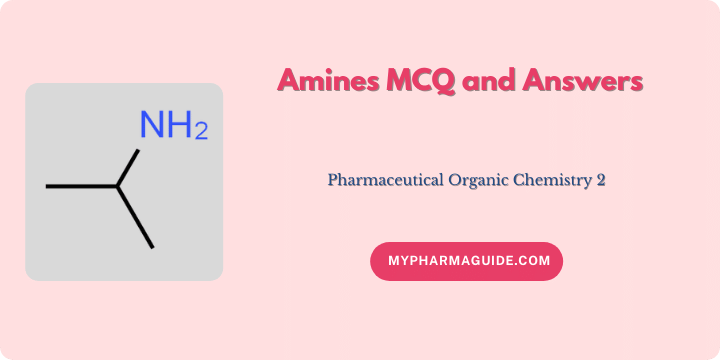

  • Important Amines MCQs with Answers

    Amines MCQs with Answers of Pharmaceutical Organic Chemistry 2 B.Pharm 3rd Semester. All the Multiple Choice Questions and Answers share in this post are extremely helpful from an exam perspective so read and learn them all.

    Important Amines MCQs with Answers
    Important Amines MCQs with Answers

    Amines MCQs with Answers | Pharmaceutical Organic Chemistry 2 | B.Pharm 3rd Semester

    1. In the conversion of Benzene diazonium salt to Fluorobenzene, the catalyst used is

    • Br2
    • CuBr
    • HBr
    • Bromine water

    Ans: CuBr

    2. In the conversion of Benzene diazonium salt to Cyanobenzene, the catalyst used is

    • HCN
    • CuCN
    • LiAlH4
    • Cyanoacetic acid

    Ans: CuCN

    3. In the conversion of 2,4-dichloroBenzene diazonium salt to 2,4-dichlorbenzene, the catalyst used is

    • NaOH
    • H3PO2
    • HCl
    • KOH

    Ans: H3PO2

    4. Product of the Hofmann elimination reaction is

    • Primary amine
    • Secondary amine
    • Tertiary amine
    • ammonia

    Ans: Tertiary amine

    5. The catalyst used in the Hofmann rearrangement reaction is

    • NaBr
    • NaOBr
    • HCl
    • NaCl

    Ans: NaOBr

    6. Intermediate formed in the Hofmann rearrangement reaction is

    • Isocyanate
    • Cyanide
    • Cyanate
    • Isothocyanate

    Ans: Isocyanate

    7. Product of the Hofmann rearrangement reaction is

    • Primary amine
    • Secondary amine
    • Tertiary amine
    • Amide

    Ans: Primary amine

    8. Hofmann rearrangement reaction is also called as

    • Migration to electron deficient carbon
    • Migration to electron rich carbon
    • Migration to electron deficient nitrogen
    • Migration to electron rich nitrogen

    Ans: Migration to electron deficient nitrogen

    9. Stereochemistry in Hofmann rearrangement reaction is

    • Inverstion of configuration
    • Retention of configuration
    • No sterochemistry is observed
    • None of the above

    Ans: Retention of configuration

    10. In the orientation of Hofmann elimination reaction of quaternary salts, E2 transition state-observed is

    • Carbocation like
    • Carbanion like
    • Alkene characte
    • Alkane character

    Ans: Carbanion like

    12. Which of the following statements is false about primary amines?

    • They can be prepared by reduction of nitriles with LiAlH4
    • They do not form salts with acids.
    • They react with ice-cold nitrous acid to form nitrogen gas.
    • They are basic and soluble in water

    Ans: They do not form salts with acids.

    13. Which of the following statements is false about secondary amines?

    • They react with chloroform and NaOH to form isocyanides.
    • They can be prepared by reduction of isocyanides.
    • They react with acid chlorides to give substituted amides.
    • They react with ice-cold nitrous acid to give nitrosamine (yellow oil).

    Ans: They react with chloroform and NaOH to form isocyanides.

    14. The hybridization of nitrogen in an amine is

    • sp
    • sp3
    • sp2
    • sp4

    Ans: sp3

    15. Which of the following compounds is a secondary amine?

    • H2NCH2CH2NH2
    • CH3CH2NHCH3
    • (CH3)3N

    Ans: CH3CH2NHCH3

    16. A sample of pure amine molecules is found to possess no intermolecular H-bonding. This sample is most likely :

    • 1° amine
    • 2° amine
    • 3° amine
    • all of the above

    Ans: 3° amine

    17. Which of the following is least soluble in water?

    • Methylamine
    • Trimethylamine
    • Dimethylamine
    • Aniline

    Ans: Aniline

    18. Which of the following is most soluble in water?

    • CH3CH2CH3
    • CH3CH2CH2Cl
    • CH3CH2CH2NH2

    Ans: CH3CH2CH2NH2

    19. Which amine is NOT soluble in water?

    • Methylamine
    • Dimethylamine
    • Trimethylamine
    • All are water-soluble

    Ans: All are water-soluble

    20. Consider a 1°, 2° and 3° amine, all of the equivalent molecular weight. Which
    amine is most likely to have the lowest boiling point?

    • 1° amine
    • 2° amine
    • 3° amine
    • None of the above

    Ans: 3° amine

    21. Which of the following will have the highest boiling point?

    • Methylamine
    • Diethylamine
    • Ethylamine
    • Triethylamine

    Ans: Triethylamine

    22. Which compound has the highest boiling point? 1.CH3CH2CH3 2. CH3CH2OH 3. CH3CH2NH2

    • 1
    • 2
    • 3
    • 2 and 3 have similar boiling points

    Ans: 2

    23. Which of the following has the highest boiling point?

    • CH3CH2CH2CH3
    • CH3CH2CH2CH2Cl
    • CH3CH2CH2CH2NH2
    • CH3CH2CH2CH2F

    Ans: CH3CH2CH2CH2NH2

    24. Amines are generally classified as

    • Weak acids
    • Strong acids
    • Weak bases
    • Strong bases

    Ans: Weak bases

    25. Acetamide reacts with Br2/NaOH to give

    • Methylamine
    • Urea
    • Ethylamine
    • Acetyl bromide

    Ans: Urea

    26. Reduction of an imine will give an

    • Acid
    • Amide
    • Amine
    • Alcohol

    Ans: Amine

    27. Which of the following is most basic?

    • Ammonia
    • Methylamine
    • Dimethylamine
    • Trimethylamine

    Ans: Dimethylamine

    28. The major product of the following reaction is :

    • 1° amine
    • 2° amine
    • 3° amines
    • amide

    Ans: 3° amines

    29. Aliphatic primary amines react with cold nitrous acid to form

    • Alcohols
    • Diazonium salts
    • Nitriles
    • Nitroalkanes

    Ans: Alcohols

    30. Which type of amine produces N2 when treated with HONO?

    • Primary
    • Secondary
    • Tertiary
    • Quaternary

    Ans: Primary

    31. Methylamine reacts with nitrous acid to form

    • CH3CH3
    • CH3OH
    • CH3NO2
    • CH3CH2OH

    Ans: CH3OH

    32. Which of the following compounds react with nitrous acid to form an
    alcohol?

    • CH3CH2NH2
    • (CH3CH2)2NH
    • (CH3CH2)3N

    Ans: (CH3CH2)2NH

    33. A nitrile can be made by dehydrating an amide. However, for this reaction to
    occur, the amide must be :

    • primary
    • secondary
    • tertiary
    • N-methylated

    Ans: primary

    34. Which of the following amines react with nitrous acid to form nitrosamine?

    • Ethylamine
    • Triethylamine
    • Diethylamine
    • Isopropylamine

    Ans: Diethylamine

    35. Which of the following does not react with acyl chlorides to form amides :

    • ammonia
    • 1° amine
    • 2° amine
    • 3° amine

    Ans: 3° amine

    36. A primary amine can be identified by using

    • HCl
    • CHCl3
    • NaOH
    • CHCl3 + KOH

    Ans: CHCl3 + KOH

    37. Carbylamine test is given by

    • Primary amines
    • Secondary amines
    • Tertiary amines
    • None of the above

    Ans: Primary amines

    38. Carbylamine test involves heating a mixture of

    • alcoholic KOH, methyl iodide, and sodium metal
    • alcoholic KOH, methyl iodide, and primary amine
    • alcoholic KOH, chloroform, and primary amine
    • alcoholic KOH, methyl alcohol, and primary amine

    Ans: alcoholic KOH, chloroform, and primary amine

    39. Acetamide on heating with P2O5 gives :

    • Methylamine
    • Ethylamine
    • Methyl cyanide
    • None of the above

    Ans: Methyl cyanide

    40. Which of the following is formed in the reaction of an aldehyde and primary amine?

    • Ketone
    • Aromatic acid
    • Schiff’s base
    • Carboxylic acid

    Ans: Schiff’s base

    Disclaimer

    The content of mypharmaguide.com is provided for information and educational purposes only. We are not the owner of any PDF Material/Books/Notes/Articles published on this website. No claim is made as to the accuracy or authenticity of the PDF Material/Books/Notes/Articles of the website. In no event will this site or owner be liable for the accuracy of the information contained on this website or its use. mypharmaguide.com provides freely available PDF Material/Books/Notes/Articles on the Internet or other resources like Links etc. This site does not take any responsibility and legal obligations due to the illegal use and abuse of any information published on the website. No responsibility is taken for any information that may appear on any linked websites.

    Conclusion

    If you also want to submit your notes to help students you can contact us for submitting your notes. To contact us click here. If you find this post ”Important Amines MCQs with Answers “ helpful then share it with your friends also.

    Download our android app MyPharmaGuide

  • Important Aromatic Amines MCQ and Answers

    Aromatic Amines MCQ with Answers of Pharmaceutical Organic Chemistry 2 B.Pharm 3rd Semester. All the Multiple Choice Questions and Answers share in this post are extremely helpful from an exam perspective so read and learn them all.

    Aromatic Amines MCQ and Answers
    Aromatic Amines MCQ and Answers

    Aromatic Amines MCQ and Answers | Pharmaceutical Organic Chemistry 2 | B.Pharm 3rd Semester

    1.Which of the following is a secondary amine

    • Aniline
    • N-Methylaniline
    • N,N-Dimethylaniline
    • Trimethylaniline

    Ans: N-Methylaniline

    2. Which of the following catalyst used to reduce the nitro group to an amine

    • LiAlH4
    • NaBH4
    • Sn, HCl
    • KMNO4

    Ans: Sn, HCl

    3. Benzaldehyde is converted to benzylamine by

    • Reduction
    • Reductive amination
    • Oxidation
    • Amination

    Ans: Reductive amination

    4. Hofmann’s degradation of amides gives

    • Primary amine
    • Secondary amine
    • Tertiary amine
    • Quaternary amine

    Ans: Primary amine

    5. Intermediate formed in Hofmann degradation is

    • Isocyanate
    • Isothiocyanate
    • Imine
    • Amine

    Ans: Isocyanate

    6. Hofmann’s elimination of quaternary ammonium salts give

    • Alkane
    • Alkene
    • Alkyne
    • Alkyl halide

    Ans: Alkene

    7. Reduced basicity of aniline is due to

    • Larger resonance stabilisation of aniline
    • Larger resonance stabilisation of its cojugate acid
    • Resonance effect
    • Inductive effect

    Ans: Larger resonance stabilisation of aniline

    8. Effect of halogens on the basicity of aniline

    • Increases
    • Decreases
    • No effect
    • Strongly increases

    Ans: Decreases

    9. 2-pentyltrimethyl ammonium ion by hofmann elimination gives____ as chief product

    • 1-Pentene
    • 2-Pentene
    • 3-Pentene
    • Both a) and B)

    Ans: 1-Pentene

    10. A reaction of N-methyl aniline with nitrous acid gives

    • Diazonium salt
    • N-Nitroso-N-methylaniline
    • P-nitroso-N-methylaniline
    • No reaction

    Ans: N-Nitroso-N-methyl aniline

    11. The amine ‘A’ when treated with nitrous acid gives a yellow oily substance. The amine A is

    • Triethylamine
    • Trimethylamine
    • Aniline
    • methylphenylamine

    Ans: Aniline

    12. The reaction of aniline with chloroform under alkaline conditions lead to the formation of

    • Phenyl isonitrile
    • Phenyl isocyanate
    • Phenyl cyanate
    • Phenyl cyanide

    Ans: Phenyl cyanide

    13. Which of the following statements about primary amines is ‘False‘?

    • Alkyl amines are stronger bases than aryl amines
    • Alkyl amines react with nitrous acid to produce alcohols
    • Aryl amines react with nitrous acid to produce alcohols
    • Alkyl amines are stronger bases than ammonia

    Ans: Aryl amines react with nitrous acid to produce alcohols

    14. Which of the following compound will not undergo azo coupling reaction with benzene diazonium chloride?

    • Aniline
    • Phenol
    • Anisole
    • Nitrobenzene

    Ans: Nitrobenzene

    You May Like Also

    Benzene and Its Derivatives MCQs

    Aromatic Acids MCQ

    15. Aromatic amine are

    • acidic in nature
    • basic in nature
    • neutral compounds
    • amphoteric compounds

    Ans: basic in nature

    16. In the conversion of Benzene diazonium salt to Fluorobenzene, the catalyst used is

    • HBF4
    • KF
    • Trifluoroacetic acid
    • CuF

    Ans: HBF4

    17. In the conversion of o-toluidine to o-cresol, the catalyst used is

    • NaNO2, H2SO4
    • HNO3
    • NaNO2
    • NaNO2, KCl

    Ans: NaNO2, H2SO4

    18. Iodobenzene can be synthesized from aniline via….

    • Grignard reagent
    • Diazonium salt
    • using KI
    • Using Iodine

    Ans: Diazonium salt

    19. Which of the following statements is false about aniline?

    • It is a primary aromatic amine.
    • It is a weak base which forms salts with acids.
    • It liberates nitrogen on treatment with ice-cold nitrous acid.
    • It can be prepared by the reduction of nitrobenzene with tin and HCl.

    Ans: It liberates nitrogen on treatment with ice-cold nitrous acid.

    20. Rank the following compounds in order of increasing base strength :

    • 1, 2, 3
    • 3, 2, 1
    • 2, 3, 1
    • 2, 1, 3

    Ans: 2, 3, 1

    21. Which of the following compounds is most basic?

    • Aniline
    • Benzylamine
    • Acetanilide
    • p-nitroaniline

    Ans: Benzylamine

    22. Which of the following is least basic?

    • Aniline
    • p-Nitroaniline
    • Ammonia
    • Trimethylamine

    Ans: p-Nitroaniline

    23. Preparation of a diazonium salt from a primary aromatic amine is known as :

    • Coupling reaction
    • Sandmeyer reaction
    • Diazotization
    • Corey-House synthesis

    Ans: Diazotization

    24. The diazonium salts are the reaction products of the reaction of nitrous acid
    with

    • primary aliphatic amines
    • primary aromatic amines
    • secondary aliphatic amines
    • secondary aromatic amines

    Ans: primary aromatic amines

    25. Which of the following statements is false about aniline?

    • It is a primary aromatic amine.
    • It is a primary aromatic amine.
    • It liberates nitrogen on treatment with ice-cold nitrous acid.
    • It can be prepared by the reduction of nitrobenzene with tin and HCl.

    Ans: It liberates nitrogen on treatment with ice-cold nitrous acid.

    26. Which of the following statements is correct about aniline?

    • is weak acid.
    • diazotizes to benzene diazonium chloride when treated with ice-cold nitrous acid
    • can be nitrated with concentrated HNO3 to form p-nitroaniline.
    • gives an intense green color with a suspension of bleaching powder in water

    Ans: diazotizes to benzene diazonium chloride when treated with ice-cold nitrous acid

    27. Which of the following statements is false about benzylamine?

    • can be prepared by reduction of benzonitrile with LiAlH4.
    • cannot be prepared by reduction of benzamide with LiAlH4.
    • reacts with nitrous acid to give benzyl alcohol.
    • reacts with KMnO4 to give benzoic acid.

    Ans: cannot be prepared by reduction of benzamide with LiAlH4.

    28. Aniline is prepared by

    • the reaction of benzene with ammonia
    • the reduction of nitrobenzene with Sn/HCl
    • the dehydrogenation of nitrobenzene
    • the reaction of nitrobenzene with I2/NaOH

    Ans: the reduction of nitrobenzene with Sn/HCl

    29. Aniline reacts with bromine water to form

    • Bromobenzene
    • m-Bromoaniline
    • 2,4,6-Tribromoaniline
    • o- plus p-Bromoaniline

    Ans: 2,4,6-Tribromoaniline

    30. Which of the following reagents does not react with aniline?

    • Acetyl chloride
    • Acetic anhydride
    • Ammonia
    • Nitrous acid

    Ans: Ammonia

    Disclaimer

    The content of mypharmaguide.com is provided for information and educational purposes only. We are not the owner of any PDF Material/Books/Notes/Articles published on this website. No claim is made as to the accuracy or authenticity of the PDF Material/Books/Notes/Articles of the website. In no event will this site or owner be liable for the accuracy of the information contained on this website or its use. mypharmaguide.com provides freely available PDF Material/Books/Notes/Articles on the Internet or other resources like Links etc. This site does not take any responsibility and legal obligations due to the illegal use and abuse of any information published on the website. No responsibility is taken for any information that may appear on any linked websites.

    Conclusion

    If you also want to submit your notes to help students you can contact us for submitting your notes. To contact us click here. If you find this post ”Important Aromatic Amines MCQ and Answers“ helpful then share it with your friends also.

    Download our android app MyPharmaGuide


  • Phenols MCQ with Answers

    Phenols MCQ with Answers of Pharmaceutical Organic Chemistry 2 B.Pharm 3rd Semester. All the Multiple Choice Questions and Answers share in this post are extremely helpful from an exam perspective so read and learn them all.

    Phenols MCQ with Answers
    Phenols MCQ with Answers

    You May Like Also

    Benzene and Its Derivatives MCQs

    Aromatic Acides MCQ

    Phenols MCQ with Answers | Pharmaceutical Organic Chemistry 2 | B.Pharm 3rd Semester

    1. Phenol can be converted to p- & o Hydroxyphenyl ethyl ketone by

    • Riemen-Tiemann reaction
    • Fries rearrangement
    • Claisens rearrangement
    • Kolbe reaction

    Ans: Fries rearrangement

    2. Phenol can be converted into salicylaldehyde by

    • Riemen-Tiemann reaction
    • Fries rearrangement
    • Claisens rearrangement
    • Kolbe reaction

    Ans: Riemen-Tiemann reaction

    3. Benzyl Phenyl ether is obtained from benzyl bromide and phenol in the presence of a catalyst

    • Con HCl
    • Con H2SO4
    • Aq HNO3
    • aq. NaOH

    Ans: aq. NaOH

    4. Which of the following is O-hydroxy phenol

    • Catechol
    • Resorcinol
    • Hydroquinone
    • Cresol

    Ans: Catechol

    5. Which of the following is p-hydroxy phenol

    • Catechol
    • Resorcinol
    • Hydroquinone
    • Cresol

    Ans: Hydroquinone

    6. Which of the following is m-hydroxy phenol

    • Catechol
    • Resorcinol
    • Hydroquinone
    • Cresol

    Ans: Resorcinol

    7. Which of the following is 3-methyl phenol

    • Catechol
    • Resorcinol
    • Hydroquinone
    • Cresol

    Ans: Cresol

    8. Phenol is soluble in

    • Aq NaOH
    • Aq NaHCO3
    • Aq HCl
    • None

    Ans: Aq NaOH

    9. Anisole can be synthesised from phenol using

    • Methyl sulfate and NaOH
    • Methyl sulfate and HCl
    • Methyl acetate and NaOH
    • Methyl acetate and HCl

    Ans: Methyl sulfate and NaOH

    10. Phenol on distillation with Zinc dust gives

    • Phenylzinc
    • Benzene
    • Cyclohexanone
    • Benzoic acid

    Ans: Benzene

    11. Phenol is an ortho-para director because the hydroxyl group :

    • donates electrons that increase electron density at ortho and para positions favouring nucleophilic attack
    • donates electrons that increase electron density at ortho and para positions favoring electrophilic attack.
    • donates electrons to the ortho and para positions and attracts electrons away from meta positions favoring nucleophilic attack of the ring.
    • donates electrons to the ortho and para positions and attracts electrons away from meta positions favoring electrophilic attack on the ring.

    Ans: donates electrons that increase electron density at ortho and para positions favoring electrophilic attack.

    12. Hydrolysis of benzal chloride gives

    • Phenol
    • Benzaldehyde
    • Benzyl alcohol
    • Benzoyl chloride

    Ans: Benzaldehyde

    13. Benzenediazonium chloride reacts with warm water to give

    • Aniline
    • Phenol
    • Benzene
    • Chlorobenzene

    Ans: Phenol

    14. Benzenediazonium chloride reacts with phenol to form :

    • p-chlorophenol
    • Chlorobenzene
    • p-Hydroxyazobenzene
    • DDT

    Ans: p-Hydroxyazobenzene

    15. Phenol is used

    • in alcoholic beverages
    • as anesthetic
    • in antiseptics
    • as moth repellant

    Ans: in antiseptics

    16. When phenol is treated with neutral FeCl3 solution, it develops

    • Violet color
    • Yellow color
    • Green color
    • None of the above

    Ans: Violet color

    17. Which of the following compounds will react with PCl5 least vigorously?

    • Ethanol
    • Acetic acid
    • Phenol
    • Benzoic acid

    Ans: Phenol

    18. Phenol reacts with excess bromine water to give

    • o- plus p-Bromophenol
    • Bromobenzene
    • 2,4,6-Tribromophenol
    • m-Bromophenol

    Ans: 2,4,6-Tribromophenol

    19. Anisole is formed when phenol is treated with

    • CH3I/NaOH
    • CH3CH2I/NaOH
    • CHCl3/NaOH
    • Acetic anhydride

    Ans: CH3I/NaOH

    20. Anisole on heating with concentrated HI gives

    • Iodobenzene
    • Phenol + CH3I
    • Iodobenzene + CH3OH
    • Phenol + CH3OH

    Ans: Phenol + CH3I

    21. Which group forms the strongest H-bonds to water molecules?

    • Alcohols
    • Ethers
    • Phenols
    • All of the above

    Ans: Phenols

    22. Which of the following compounds will react with PCl5 least vigorously?

    • Ethanol
    • Acetic acid
    • Phenol
    • Benzoic acid

    Ans: Phenol

    23. When phenol is treated with neutral FeCl3 solution, it develops

    • Violet color
    • Yellow color
    • Green color
    • None of the above

    Ans: Violet Colour

    24. Phenol is acidic because of

    • Resonance
    • Electromeric effect
    • Inductive effect
    • Peroxide effect

    Ans: Resonance

    25. Which of the following has the most acidic proton?

    • Thiol
    • Alcohol
    • Phenol
    • Ether

    Ans: Phenol

    26. Phenol is

    • stronger acid than acetic acid
    • weaker acid than acetic acid
    • stronger base than methylamine
    • weaker base than methylamine

    Ans: weaker acid than acetic acid

    27. Which of the following compounds is most acidic?

    • o-Cresol
    • p-Nitrophenol
    • p-Cresol
    • p-Chlorophenol

    Ans: p-Nitrophenol

    28. Which of the following compounds is most acidic?

    • Phenol
    • m-Nitrophenol
    • m-Cresol
    • m-Bromophenol

    Ans: m-Nitrophenol

    29. Phenols can be easily distinguished from alcohols because

    • phenols are soluble in NaOH, but alcohols are not
    • alcohols are soluble in NaOH, but phenols are not
    • phenols are soluble in NaHCO3, but alcohols are not
    • alcohols are soluble in NaHCO3, but phenols are not

    Ans: phenols are soluble in NaOH, but alcohols are not

    30. Which of the following statements is true :

    • o-Nitrobenzoic acid is more acidic than p-nitrophenol
    • o-Nitrobenzoic acid is less acidic than p-nitrophenol
    • o-Nitrobenzoic acid and p-nitrobenzoic acid have the same acid strength
    • None of these

    Ans: o-Nitrobenzoic acid is more acidic than p-nitrophenol

    31. Bakelite is obtained from :

    • Phenol and formaldehyde
    • Adipic acid and hexamethylene diamine
    • Dimethyl terephthalate and ethylene glycol
    • Neoprene

    Ans: Phenol and formaldehyde

    Disclaimer

    The content of mypharmaguide.com is provided for information and educational purposes only. We are not the owner of any PDF Material/Books/Notes/Articles published on this website. No claim is made as to the accuracy or authenticity of the PDF Material/Books/Notes/Articles of the website. In no event will this site or owner be liable for the accuracy of the information contained on this website or its use. mypharmaguide.com provides freely available PDF Material/Books/Notes/Articles on the Internet or other resources like Links etc. This site does not take any responsibility and legal obligations due to the illegal use and abuse of any information published on the website. No responsibility is taken for any information that may appear on any linked websites.

    Conclusion

    If you also want to submit your notes to help students you can contact us for submitting your notes. To contact us click here. If you find this post  ”Phenols MCQ and Answers “ helpful then share it with your friends also.

    Download our android app MyPharmaGuide


  • Aromatic Acids MCQ and Answers

    Aromatic Acids MCQ and Answers of Pharmaceutical Organic Chemistry 2 B.Pharm 3rd Semester. All the Multiple Choice Questions and Answers share in this post are extremely helpful from an exam perspective so read and learn them all.

    Join Our Telegram Channel

    1. Alcohols can be converted into carboxylic acids by

    • oxidation
    • Reduction
    • Hydrolysis
    • Eliminatione

    Ans: oxidation

    2. Alkyl halides can be converted into carboxylic acid by

    • oxidation
    • Reduction
    • via grignard reagent
    • Hydrolysis

    Ans: via grignard reagent

    3. Carboxylic acids can be converted into primary alcohol by

    • Oxidation using KMNO4
    • Reduction using LiAlH4
    • Hydrolysis using NaOH
    • Ester formation

    Ans: Reduction using LiAlH4

    4. Carboxylic acids are more acidic than alcohols due to

    • Resonance stabilization of conjugate base of acid is small
    • Resonance stabilization of conjugate base of acid is large
    • Resonance stabilization of acid is small
    • Resonance stabilization of acid is large

    Ans: Resonance stabilization of conjugate base of acid is large

    5. Effect of the ortho-OCH3 group on the acidity of benzoic acid

    • Increases
    • Decreases
    • No effect
    • Strongly increases

    Ans: Decreases

    6. Effect of the ortho-NO2 group on the acidity of benzoic acid

    • Increases
    • Decreases
    • No effect
    • Strongly increases

    Ans: Increases

    7. Phenol can be converted to p- & o Hydroxyphenyl ethyl ketone by

    • Riemen-Tiemann reaction
    • Fries rearrangement
    • Claisens rearrangement
    • Kolbe reaction

    Ans: Fries rearrangement

    8. Carbonation of Grignard reagent leads to the synthesis of

    • Alkyl halide
    • Carboxylic acid
    • Aldehyde
    • Ketone

    Ans: Carboxylic acid

    9. Acyl chloride can be synthesised from carboxylic acid using

    • HCl
    • NaCl
    • SOCl2
    • KCl

    Ans: SOCl2

    More Aromatic Acids MCQ and Answers will be soon….

    Disclaimer

    The content of mypharmaguide.com is provided for information and educational purposes only. We are not the owner of any PDF Material/Books/Notes/Articles published on this website. No claim is made as to the accuracy or authenticity of the PDF Material/Books/Notes/Articles of the website. In no event will this site or owner be liable for the accuracy of the information contained on this website or its use. mypharmaguide.com provides freely available PDF Material/Books/Notes/Articles on the Internet or other resources like Links etc. This site does not take any responsibility and legal obligations due to the illegal use and abuse of any information published on the website. No responsibility is taken for any information that may appear on any linked websites.

    Conclusion

    If you also want to submit your notes to help students you can contact us for submitting your notes. To contact us click here. If you find this post ”  Aromatic Acids MCQ and Answers “ helpful then share it with your friends also.

    Download our android app MyPharmaGuide


  • Benzene and its Derivatives MCQ and Answers

    Benzene and its Derivatives MCQ and Answers of Pharmaceutical Organic Chemistry 2 B.Pharm 2nd Semester. All the Multiple Choice Questions and Answers share in this post are extremely helpful from an exam perspective so read and learn them all.

    Join Our Telegram Channel

    Benzene and its Derivatives MCQ and Answers
    Benzene and its Derivatives MCQ and Answers

    1. The molecule must have ______ π electrons to be
    aromatic compound

    • 2n+2
    • 4n+2
    • 6n+2
    • 8n+2

    Ans: 4n+2

    2. Cyclopentadienyl cation is

    • Aromatic
    • Not aromatic
    • Contains Five π electrons
    • Heterocycle

    Ans: Aromatic

    3. Electrophiles are

    • Rich in electrons
    • Neutral
    • More affinity to nucleas
    • Less affinity to nucleas

    Ans: More affinity to nucleas

    4. Catalyst used in Friedel-crafts alkylation is

    • Ammonium chloride
    • Aluminium chloride
    • Calcium chloride
    • Sodium chloride

    Ans: Aluminium chloride


    5. Kolbe reaction is a characteristic reaction for

    • Carboxylic acids
    • Amines
    • Phenols
    • Alcohols

    Ans: Phenols

    6. Reimer-Tiemann reaction is a characteristic reaction for

    • Carboxylic acids
    • Amines
    • Phenols
    • Alcohols

    Ans: Phenols

    7. Which of the following is a weakly activating group

    • -F
    • -Br
    • -NH2
    • -C2H5

    Ans: -C2H5

    8. In the mechanism of electrophilic aromatic substitution reaction, intermediate formed is

    • Carbocation
    • Carbanion
    • Neutral
    • Basic

    Ans: Carbocation

    9. In the mechanism of electrophilic aromatic substitution reaction

    • Ist step is rate determining step
    • IInd step is slow step
    • IInd step is rate determining step
    • Ist step is Fast step

    Ans: 1st Step is the rate-determining step

    10. Electron releasing group in an electrophilic aromatic substitution reaction

    • Stabilizes Carbocation
    • Destabilizes Carbocation
    • Deactivates ring
    • Do not have any effect

    Ans: Stabilizes Carbocation

    11. Chloro group is

    • Electron withdrawing by resonance effect
    • Electron withdrawing by inductive effect
    • Electron withdrawing by both inductive and resonance effect
    • Electron donating by both inductive and resonance effect

    Ans: Electron withdrawing by inductive effect


    12. Toluene undergoes electrophilic aromatic substitution reaction to give

    • Only para substituted product
    • Only ortho substituted product
    • Both para and ortho substituted product
    • Meta substituted product

    Ans: Both para and ortho substituted product

    13. Nitrobenzene undergoes an electrophilic aromatic substitution reaction to give

    • Only para substituted product
    • Only ortho substituted product
    • Both para and ortho substituted product
    • Meta substituted product

    Ans: Meta substituted product

    14. Chlorobenzene undergoes electrophilic aromatic substitution reaction to give

    • Only para substituted product
    • Only ortho substituted product
    • Both para and ortho substituted product
    • Meta substituted product

    Ans: Both para and ortho substituted product


    15. In the case of carbocation intermediate in electrophilic aromatic substitution of aniline, stable resonance structure has

    • Pentet electrons
    • hextet electrons
    • heptet electrons
    • octet electrons

    Ans: octet electrons

    16. Iodobenzene undergoes the electrophilic aromatic substitution reaction to give

    • Only para substituted product
    • Only ortho substituted product
    • Both para and ortho substituted product
    • Meta substituted product

    Ans: Both para and ortho substituted product

    17. Protonated dimethylaniline undergoes the electrophilic aromatic substitution reaction to give

    • Only para substituted product
    • Only ortho substituted product
    • Both para and ortho substituted product
    • Meta substituted product

    Ans: Meta substituted product

    18. Benzaldehyde undergoes nitration reaction to give

    • Only para substituted product
    • Only ortho substituted product
    • Both para and ortho substituted product
    • Meta substituted product

    Ans: Meta substituted product

    19. Acetanilide undergoes nitration reaction to give

    • Only para substituted product
    • Only ortho substituted product
    • Both para and ortho substituted product
    • Meta substituted product

    Ans: Both para and ortho substituted product

    20. 4- methyl acetanilide undergoes bromination gives chief product i.e.,

    • 2-bromo-4- methyl acetanilide
    • 3-bromo-4- methyl acetanilide
    • 5-bromo-4- methyl acetanilide
    • 2,3-dibromo-4- methyl acetanilide

    Ans: 2-bromo-4- methyl acetanilide

    21. 4-hydroxy toluene on nitration gives ____ as chief product

    • 2-Nitro-4-hydroxy toluene
    • 3-Nitro-4-hydroxy toluene
    • 2,6-Dinitro-4-hydroxy toluene
    • 3,5-Dinitro-4-hydroxy toluene

    Ans: 3-Nitro-4-hydroxy toluene

    22. What is the name of C6H5-CH2 group?

    • aryl
    • arenyl
    • benzyl
    • phenyl

    Ans: benzyl

    23. Which will not result in a reaction?

    • C6H5OH + Br2
    • C6H5OH + NaOH
    • C6H5OH + Na2CO3
    • C6H5OH + HNO3/H2SO4

    Ans: C6H5OH + Na2CO3

    24. Which of the following represents the best reagent(s) for the electrophilic nitration of benzene?

    • NO2
    • HNO2
    • HNO3
    • H2SO4, HNO3

    Ans: H2SO4, HNO3

    25. Predict the major product when nitrobenzene reacts with methyl chloride in the presence of aluminium chloride

    • nitrobenzene
    • o-nitrotoluene and p-nitrotoluene
    • m-nitrotoluene
    • chlorobenzene

    Ans: m-nitrotoluene

    26. Predict the major product when toluene reacts with methyl chloride in the presence of aluminium chloride

    • o-chlorotoluene and p-chlorotoluene
    • m-chlorotoluene
    • o-dimethylbenzene and p-dimethylbenzene
    • m-dimethylbenzene

    Ans: o-dimethylbenzene and p-dimethylbenzene

    27. Aldehyde group in benzaldehyde is

    • ortho and para directing
    • meta directing
    • para directing
    • ortho directing

    Ans: meta directing

    28. Bromine group in bromobenzene is

    • ortho and para directing
    • meta directing
    • para directing
    • ortho directing

    Ans: ortho and para directing

    29. Which of the following statements is incorrect for aromatic compounds

    • Are planar
    • Have 4n+2 π-electrons
    • Have 4n π-electrons
    • Are cyclic

    Ans: Have 4n π-electrons

    30. When considering electrophilic aromatic substitution reactions electron-donating
    substituents (e.g. methoxy) are described as

    • ortho/para directing and activating
    • ortho/para directing and deactivating
    • meta directing and activating
    • meta directing and deactivating

    Ans: ortho/para directing and activating

    31. How many pairs of degenerate π molecular orbitals are found in benzene?

    • 6
    • 5
    • 4
    • 2

    Ans: 2

    32. Chemically DDT is

    • dichlorodiphenyltrichloroethane
    • dichloroethane
    • trichloroethane
    • dichloropropane
    • trichlorobutane

    Ans: dichlorodiphenyltrichloroethane

    33. Saccharine is a derivative of

    • benzothiazole
    • benzotriazole
    • benzimidazole
    • benzoxazole

    Ans: benzothiazole

    34. Chloramine is used as

    • preservative
    • artificial sweetener
    • disinfectant
    • flavouring agent

    Ans: disinfectant

    35. Saccharine is used as

    • preservative
    • artificial sweetener
    • flavouring agent
    • colouring agent

    Ans: artificial sweetener

    Disclaimer

    The content of mypharmaguide.com is provided for information and educational purposes only. We are not the owner of any PDF Material/Books/Notes/Articles published on this website. No claim is made as to the accuracy or authenticity of the PDF Material/Books/Notes/Articles of the website. In no event will this site or owner be liable for the accuracy of the information contained on this website or its use. mypharmaguide.com provides freely available PDF Material/Books/Notes/Articles on the Internet or other resources like Links etc. This site does not take any responsibility and legal obligations due to the illegal use and abuse of any information published on the website. No responsibility is taken for any information that may appear on any linked websites.

    Conclusion

    If you also want to submit your notes to help students you can contact us for submitting your notes. To contact us click here. If you find this post ” Benzene and its Derivatives MCQ and Answers “ helpful then share it with your friends also.

    Download our android app MyPharmaGuide

  • Free PTCB 90 Question Practice Test

    Are you searching for PTCB 90 Question Practice Test then you are in right place. Here in this post of MyPharmaGuide we have collected very very important 90 Questions for PTCB and made a Practice Test. This Practice Test of 90 Questions is extremely helpful for the aspirants of the PTCB examination. We hope that this Practice test will be extremely helpful for everyone.

    [ays_quiz id=”38″]
  • Free Practice Questions for NCLEX-2022

    Are you looking for Practice Questions for NCLEX? Then you are in the right place. We have a collection of many important and tricky questions for NCLEX which will be extremely helpful for your practice for the NCLEX Examination. All the questions have a detailed answer. If you select a wrong or right answer you will get a detailed explanation for the answer.

    [ays_quiz id=”37″]
    Free Practice Questions for NCLEX-2022
    Free Practice Questions for NCLEX-2022

    Does we need to write both NCLEX and CGFNS exam for USA?

    NCLEX is the national licensing exam required of all nurses who wish to work as nurses in the US, whether a graduate from the US or overseas.CGFNS is specifically for graduates of foreign nursing schools. It was created about 25 years ago as a precursor to a nurse being sent to the US to work. Back then you could come on just a simple temporary work permit, but those are no longer available.

    Can I go to South Korea after passing nclex-rn?

    Foreign nurses can work in Korea after taking the nurse license. But foreign nurses have to graduate from nursing colleges admitted by MOHW (Ministry of Health & Welfare) if they want to take the KNLE (Korean Nurses’ Licensing Examination).

    Which are the drugs I must know before appearing for my nclex?

    The drugs are: Cardiac glycoside, Beta-blockers, Calcium channel blockers, Anti-depressants, Anti-anxiety, Anti-anginals, Insulins, Oral anti-diabetic, Anti-biotics, Pain killers, Naloxone, Diuretics, Bronchodilators, Steroids, Anti-coagulants, Anti-neoplastics, Anti-platelet, Anaphylaxis, Anti-dysrhythmia, Thyroid, Stool softener, Anti-cholesterol meds etc

    Which US states does not require IELTS with Nclex?

    I would suggest before you do anything is check with the state you plan on living and working and check what is required when IEN and endorsing a license. Many states still require the same requirements when endorsing if trained outside the US.

    Is Nclex required to work in London?

    yes, but it is quite the test. First, the non-EU nurse has to go through a set of steps to enter the country to be able to work. That’s pretty standard when wanting to move abroad for work. Once that’s completed, the non-EU nurse is then able to start working, but only as a nurse assistant until a clinical test called the OSCE is completed.