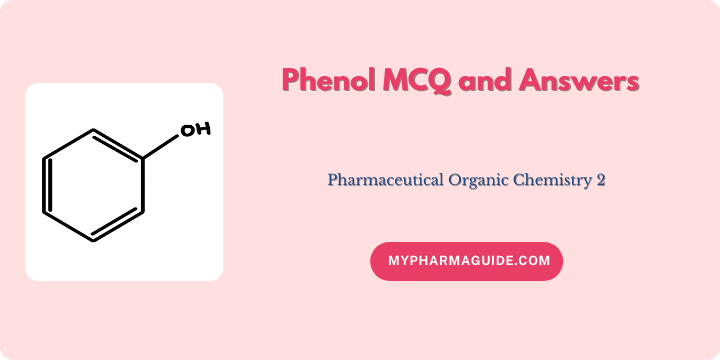
Phenols MCQ with Answers of Pharmaceutical Organic Chemistry 2 B.Pharm 3rd Semester. All the Multiple Choice Questions and Answers share in this post are extremely helpful from an exam perspective so read and learn them all.
1. Phenol can be converted to p- & o Hydroxyphenyl ethyl ketone by
Riemen-Tiemann reaction
Fries rearrangement
Claisens rearrangement
Kolbe reaction
Ans: Fries rearrangement
2. Phenol can be converted into salicylaldehyde by
Riemen-Tiemann reaction
Fries rearrangement
Claisens rearrangement
Kolbe reaction
Ans: Riemen-Tiemann reaction
3. Benzyl Phenyl ether is obtained from benzyl bromide and phenol in the presence of a catalyst
Con HCl
Con H2SO4
Aq HNO3
aq. NaOH
Ans: aq. NaOH
4. Which of the following is O-hydroxy phenol
Catechol
Resorcinol
Hydroquinone
Cresol
Ans: Catechol
5. Which of the following is p-hydroxy phenol
Catechol
Resorcinol
Hydroquinone
Cresol
Ans: Hydroquinone
6. Which of the following is m-hydroxy phenol
Catechol
Resorcinol
Hydroquinone
Cresol
Ans: Resorcinol
7. Which of the following is 3-methyl phenol
Catechol
Resorcinol
Hydroquinone
Cresol
Ans: Cresol
8. Phenol is soluble in
Aq NaOH
Aq NaHCO3
Aq HCl
None
Ans: Aq NaOH
9. Anisole can be synthesised from phenol using
Methyl sulfate and NaOH
Methyl sulfate and HCl
Methyl acetate and NaOH
Methyl acetate and HCl
Ans: Methyl sulfate and NaOH
10. Phenol on distillation with Zinc dust gives
Phenylzinc
Benzene
Cyclohexanone
Benzoic acid
Ans: Benzene
11. Phenol is an ortho-para director because the hydroxyl group :
donates electrons that increase electron density at ortho and para positions favouring nucleophilic attack
donates electrons that increase electron density at ortho and para positions favoring electrophilic attack.
donates electrons to the ortho and para positions and attracts electrons away from meta positions favoring nucleophilic attack of the ring.
donates electrons to the ortho and para positions and attracts electrons away from meta positions favoring electrophilic attack on the ring.
Ans: donates electrons that increase electron density at ortho and para positions favoring electrophilic attack.
12. Hydrolysis of benzal chloride gives
Phenol
Benzaldehyde
Benzyl alcohol
Benzoyl chloride
Ans: Benzaldehyde
13. Benzenediazonium chloride reacts with warm water to give
Aniline
Phenol
Benzene
Chlorobenzene
Ans: Phenol
14. Benzenediazonium chloride reacts with phenol to form :
p-chlorophenol
Chlorobenzene
p-Hydroxyazobenzene
DDT
Ans: p-Hydroxyazobenzene
15. Phenol is used
in alcoholic beverages
as anesthetic
in antiseptics
as moth repellant
Ans: in antiseptics
16. When phenol is treated with neutral FeCl3 solution, it develops
Violet color
Yellow color
Green color
None of the above
Ans: Violet color
17. Which of the following compounds will react with PCl5 least vigorously?
Ethanol
Acetic acid
Phenol
Benzoic acid
Ans: Phenol
18. Phenol reacts with excess bromine water to give
o- plus p-Bromophenol
Bromobenzene
2,4,6-Tribromophenol
m-Bromophenol
Ans: 2,4,6-Tribromophenol
19. Anisole is formed when phenol is treated with
CH3I/NaOH
CH3CH2I/NaOH
CHCl3/NaOH
Acetic anhydride
Ans: CH3I/NaOH
20. Anisole on heating with concentrated HI gives
Iodobenzene
Phenol + CH3I
Iodobenzene + CH3OH
Phenol + CH3OH
Ans: Phenol + CH3I
21. Which group forms the strongest H-bonds to water molecules?
Alcohols
Ethers
Phenols
All of the above
Ans: Phenols
22. Which of the following compounds will react with PCl5 least vigorously?
Ethanol
Acetic acid
Phenol
Benzoic acid
Ans: Phenol
23. When phenol is treated with neutral FeCl3 solution, it develops
Violet color
Yellow color
Green color
None of the above
Ans: Violet Colour
24. Phenol is acidic because of
Resonance
Electromeric effect
Inductive effect
Peroxide effect
Ans: Resonance
25. Which of the following has the most acidic proton?
Thiol
Alcohol
Phenol
Ether
Ans: Phenol
26. Phenol is
stronger acid than acetic acid
weaker acid than acetic acid
stronger base than methylamine
weaker base than methylamine
Ans: weaker acid than acetic acid
27. Which of the following compounds is most acidic?
o-Cresol
p-Nitrophenol
p-Cresol
p-Chlorophenol
Ans: p-Nitrophenol
28. Which of the following compounds is most acidic?
Phenol
m-Nitrophenol
m-Cresol
m-Bromophenol
Ans: m-Nitrophenol
29. Phenols can be easily distinguished from alcohols because
phenols are soluble in NaOH, but alcohols are not
alcohols are soluble in NaOH, but phenols are not
phenols are soluble in NaHCO3, but alcohols are not
alcohols are soluble in NaHCO3, but phenols are not
Ans: phenols are soluble in NaOH, but alcohols are not
30. Which of the following statements is true :
o-Nitrobenzoic acid is more acidic than p-nitrophenol
o-Nitrobenzoic acid is less acidic than p-nitrophenol
o-Nitrobenzoic acid and p-nitrobenzoic acid have the same acid strength
None of these
Ans: o-Nitrobenzoic acid is more acidic than p-nitrophenol
31. Bakelite is obtained from :
Phenol and formaldehyde
Adipic acid and hexamethylene diamine
Dimethyl terephthalate and ethylene glycol
Neoprene
Ans: Phenol and formaldehyde
Disclaimer
The content of mypharmaguide.com is provided for information and educational purposes only. We are not the owner of any PDF Material/Books/Notes/Articles published on this website. No claim is made as to the accuracy or authenticity of the PDF Material/Books/Notes/Articles of the website. In no event will this site or owner be liable for the accuracy of the information contained on this website or its use. mypharmaguide.com provides freely available PDF Material/Books/Notes/Articles on the Internet or other resources like Links etc. This site does not take any responsibility and legal obligations due to the illegal use and abuse of any information published on the website. No responsibility is taken for any information that may appear on any linked websites.
Conclusion
If you also want to submit your notes to help students you can contact us for submitting your notes. To contact us click here. If you find this post ”Phenols MCQ and Answers “ helpful then share it with your friends also.
Aromatic Acids MCQ and Answers of Pharmaceutical Organic Chemistry 2 B.Pharm 3rd Semester. All the Multiple Choice Questions and Answers share in this post are extremely helpful from an exam perspective so read and learn them all.
1. Alcohols can be converted into carboxylic acids by
oxidation
Reduction
Hydrolysis
Eliminatione
Ans: oxidation
2. Alkyl halides can be converted into carboxylic acid by
oxidation
Reduction
via grignard reagent
Hydrolysis
Ans: via grignard reagent
3. Carboxylic acids can be converted into primary alcohol by
Oxidation using KMNO4
Reduction using LiAlH4
Hydrolysis using NaOH
Ester formation
Ans: Reduction using LiAlH4
4. Carboxylic acids are more acidic than alcohols due to
Resonance stabilization of conjugate base of acid is small
Resonance stabilization of conjugate base of acid is large
Resonance stabilization of acid is small
Resonance stabilization of acid is large
Ans: Resonance stabilization of conjugate base of acid is large
5. Effect of the ortho-OCH3 group on the acidity of benzoic acid
Increases
Decreases
No effect
Strongly increases
Ans: Decreases
6. Effect of the ortho-NO2 group on the acidity of benzoic acid
Increases
Decreases
No effect
Strongly increases
Ans: Increases
7. Phenol can be converted to p- & o Hydroxyphenyl ethyl ketone by
Riemen-Tiemann reaction
Fries rearrangement
Claisens rearrangement
Kolbe reaction
Ans: Fries rearrangement
8. Carbonation of Grignard reagent leads to the synthesis of
Alkyl halide
Carboxylic acid
Aldehyde
Ketone
Ans: Carboxylic acid
9. Acyl chloride can be synthesised from carboxylic acid using
HCl
NaCl
SOCl2
KCl
Ans: SOCl2
More Aromatic Acids MCQ and Answers will be soon….
Disclaimer
The content of mypharmaguide.com is provided for information and educational purposes only. We are not the owner of any PDF Material/Books/Notes/Articles published on this website. No claim is made as to the accuracy or authenticity of the PDF Material/Books/Notes/Articles of the website. In no event will this site or owner be liable for the accuracy of the information contained on this website or its use. mypharmaguide.com provides freely available PDF Material/Books/Notes/Articles on the Internet or other resources like Links etc. This site does not take any responsibility and legal obligations due to the illegal use and abuse of any information published on the website. No responsibility is taken for any information that may appear on any linked websites.
Conclusion
If you also want to submit your notes to help students you can contact us for submitting your notes. To contact us click here. If you find this post ” Aromatic Acids MCQ and Answers “ helpful then share it with your friends also.
Benzene and its Derivatives MCQ and Answers of Pharmaceutical Organic Chemistry 2 B.Pharm 2nd Semester. All the Multiple Choice Questions and Answers share in this post are extremely helpful from an exam perspective so read and learn them all.
21. 4-hydroxy toluene on nitration gives ____ as chief product
2-Nitro-4-hydroxy toluene
3-Nitro-4-hydroxy toluene
2,6-Dinitro-4-hydroxy toluene
3,5-Dinitro-4-hydroxy toluene
Ans: 3-Nitro-4-hydroxy toluene
22. What is the name of C6H5-CH2 group?
aryl
arenyl
benzyl
phenyl
Ans: benzyl
23. Which will not result in a reaction?
C6H5OH + Br2
C6H5OH + NaOH
C6H5OH + Na2CO3
C6H5OH + HNO3/H2SO4
Ans: C6H5OH + Na2CO3
24. Which of the following represents the best reagent(s) for the electrophilic nitration of benzene?
NO2
HNO2
HNO3
H2SO4, HNO3
Ans: H2SO4, HNO3
25. Predict the major product when nitrobenzene reacts with methyl chloride in the presence of aluminium chloride
nitrobenzene
o-nitrotoluene and p-nitrotoluene
m-nitrotoluene
chlorobenzene
Ans: m-nitrotoluene
26. Predict the major product when toluene reacts with methyl chloride in the presence of aluminium chloride
o-chlorotoluene and p-chlorotoluene
m-chlorotoluene
o-dimethylbenzene and p-dimethylbenzene
m-dimethylbenzene
Ans: o-dimethylbenzene and p-dimethylbenzene
27. Aldehyde group in benzaldehyde is
ortho and para directing
meta directing
para directing
ortho directing
Ans: meta directing
28. Bromine group in bromobenzene is
ortho and para directing
meta directing
para directing
ortho directing
Ans: ortho and para directing
29. Which of the following statements is incorrect for aromatic compounds
Are planar
Have 4n+2 π-electrons
Have 4n π-electrons
Are cyclic
Ans: Have 4n π-electrons
30. When considering electrophilic aromatic substitution reactions electron-donating substituents (e.g. methoxy) are described as
ortho/para directing and activating
ortho/para directing and deactivating
meta directing and activating
meta directing and deactivating
Ans: ortho/para directing and activating
31. How many pairs of degenerate π molecular orbitals are found in benzene?
6
5
4
2
Ans: 2
32. Chemically DDT is
dichlorodiphenyltrichloroethane
dichloroethane
trichloroethane
dichloropropane
trichlorobutane
Ans: dichlorodiphenyltrichloroethane
33. Saccharine is a derivative of
benzothiazole
benzotriazole
benzimidazole
benzoxazole
Ans: benzothiazole
34. Chloramine is used as
preservative
artificial sweetener
disinfectant
flavouring agent
Ans: disinfectant
35. Saccharine is used as
preservative
artificial sweetener
flavouring agent
colouring agent
Ans: artificial sweetener
Disclaimer
The content of mypharmaguide.com is provided for information and educational purposes only. We are not the owner of any PDF Material/Books/Notes/Articles published on this website. No claim is made as to the accuracy or authenticity of the PDF Material/Books/Notes/Articles of the website. In no event will this site or owner be liable for the accuracy of the information contained on this website or its use. mypharmaguide.com provides freely available PDF Material/Books/Notes/Articles on the Internet or other resources like Links etc. This site does not take any responsibility and legal obligations due to the illegal use and abuse of any information published on the website. No responsibility is taken for any information that may appear on any linked websites.
Conclusion
If you also want to submit your notes to help students you can contact us for submitting your notes. To contact us click here. If you find this post ” Benzene and its Derivatives MCQ and Answers “ helpful then share it with your friends also.
Pharmacy Council of India has issued a gazette for Diploma in Pharmacy Exit Examination on 24th February of 2022 that ordered that from the session 2021-22, the Diploma in Pharmacy students have been made mandatory to have the exit exam for becoming a registered pharmacist in the Pharmacy Council and obtaining a retail drug permit after passing the diploma. All Candidates will be eligible for registration as Pharmacist in State Pharmacy Counseling only after passing the Diploma in Pharmacy exit examination.
If you are a D.Pharm 2nd Year student then this article is going to be an awesome article. In this article, we are going to share some valuable information regarding this circular like Exam type, How many times the exam will be conducted in a year? What will be the syllabus of the exam? What will be the passing marks like many other questions. So read the whole article carefully and gain some awesome knowledge regarding Diploma in Pharmacy Exit Examination.
What is Diploma in Pharmacy Exit Examination ?
Pharmacy Council of India on 24th February 2022 released a gazette where PCI makes it mandatory to attend an Exit Examination for Diploma in Pharmacy Students to be eligible to become a Pharmacist and to apply for Pharmacist Registration. Only students who have passed the Diploma in Pharmacy course with more than 50% score will be only eligible for the course. This exit examination of Diploma in Pharmacy or D.Pharm students is known as Diploma in Pharmacy Exit Examination (DPEE).
The objective of the Diploma in Pharmacy Exit Examination (DPEE) is to ensure that a candidate applying for registration as a pharmacist with the State Pharmacy Council has undergone pharmacy education and a comprehensive practical training programme in Diploma in Pharmacy (D.Pharm) course as provided in the Education Regulations, 2020 or the regulations that may be in force from time to time in an institution approved by Pharmacy Council of India under section 12 of the Pharmacy Act, 1948 and acquired core competencies in dispensing of medicines and other areas of pharmacy practice and to reinforce his discipline, integrity, judgement, skills, knowledge and quest for learning so that after having passed the examination he is able to become a registered pharmacist who is able to exercise his professional skills in addition to carrying his duty and responsibilities professionally.
Frequency of Diploma in Pharmacy Examination
According to the gazatte released Diploma in Pharmacy Examination will be held two times in a year.
Information regarding the Date of Examinations and Centre of Examination will be shared with the candidate by the Prescribed Authority based on available centre.
Eligibility of Diploma in Pharmacy Examination
Diploma in Pharmacy degree holder who has already gain practical knowledge.
Students have to gain the Diploma in Pharmacy degree from PCI approved Institute.
Students have to pass the Diploma in Pharmay course with minimum of 50% marks in each paper separately.
Syllabus of Diploma in Pharmacy Exit Examination
A Detailed syllabus of this examination will be shared in near future by the Pharmacy Council of India.
There will be three papers of multiple choice questions in Pharmaceutics, Pharmacology, Pharmacognosy, Biochemistry, Pharmaceutical Chemistry, Hospital and Clicnical Pharmacy, Pharmaceutical Jurisprudence and Drug Store and Business Management.
The question of the exam will be Multiple Choice Question type.
Is Exit Examination is Mandatory for B.Pharm Students also?
No, there is no news regarding this matter. However, the Pharmacy Council of India is thinking to Introduce the Exit Examination for B.Pharm students also.
Conclusion
Pharmacy Council of India has taken a good decision in the betterment of Pharmacy carrier. Many institutes were offering D.Pharm degrees to students without attending the colleges, exams. This examination will increase the value of Pharmacy education in India at a global level.
Download Pharmacovigilance Books PDF For Free. In this post of MyPharmaGuide, we have shared Free Books For the subject of Pharmacovigilance. All these books going to be extremely helpful for your studies. So Download them for free and start learning. Pharmacovigilance is the science and activity which is related to the detection, assessment, understanding, and prevention of adverse effects or any other medicine/vaccine-related problems.
Pharmacovigilance Books Free Download
A Practical Guides On Pharmacovigilance For Beginners
Book Name
A Practical Guides On Pharmacovigilance For Beginners
Pharmacovigilance-Related Topics at the Level of the International Conference on Harmonisation
Periodic Safety Update Reports
Non-Clinical Safety Evaluation and Adverse Events in Phase I Trials
Mechanisms of Adverse Drug Reactions
Micturin and Torsades de Pointes
Withdrawal of Terodiline: A Tale of Two Toxicities
Nomifensine and Haemolytic Anaemia
WHO Programme – Global Monitoring
Medical Dictionary for Regulatory Activities (MedDRA®)
Regulatory Pharmacovigilance in the EU
Spontaneous Reporting – UK
Spontaneous Reporting – France
Spontaneous Reporting in Germany
Spontaneous Reporting – United States
Statistical Methods of Signal Detection
Statistical Methods of Evaluating Pharmacovigilance Data
Data Mining in Pharmacovigilance: A View from the Uppsala Monitoring Centre
Pharmacovigilance in the Netherlands
CIOMS Working Groups and their Contribution to Pharmacovigilance
PEM in the UK
PEM in New Zealand
MEMO in the United Kingdom
The General Practice Research Database: Now and the Future
Overview of North American Databases
Other Databases in Europe for the Analytic Evaluation of Drug Effects
Surveillance for Medical Devices – USA
Pharmacovigilance and Risk Management in Japan
Dermatological ADRs
Gastrointestinal ADRs
Haematological ADRs
Hepatic ADRs
Ocular Side Effects of Prescription Medications
Drug Safety in Pregnancy
Renal Adverse Drug Reactions
Anaesthetic Adverse Drug Reactions.
Pharmacovigilance in Pediatrics
The Cardiovascular Spectrum of Adverse Drug Reactions
Drugs and the Elderly
US Activities in Risk Management of Pharmaceutical Products
Risk Management – a European Regulatory View
The Efficacy and Safety of Selective Serotonin Reuptake Inhibitors for the Treatment of Depression in Children and Adolescents
Pharmacoepidemiology of Hormone Therapy: An Evolving Picture
NSAIDs – COX-2 Inhibitors – Risks and Benefits
Introduction to Pharmionics: The Vagaries in Ambulatory Patients’ Adherence to Prescribed Drug Dosing Regimens, and Some of Their Clinical and Economic Consequences
Teaching and Learning Pharmacovigilance
Practical Experience in Teaching Pharmacovigilance
Fatal Medication Errors and Adverse Drug Reactions – Coroners’ Inquests and Other Sources
The content of mypharmaguide.com is provided for information and educational purposes only. We are not the owner of any PDF Material/Books/Notes/Articles published on this website. No claim is made as to the accuracy or authenticity of the PDF Material/Books/Notes/Articles of the website. In no event will this site or owner be liable for the accuracy of the information contained on this website or its use. mypharmaguide.com provides freely available PDF Material/Books/Notes on the Internet or other resources like Links etc. This site does not take any responsibility and legal obligations due to illegal use and abuse of any service. No responsibility is taken for any information that may appear on any linked websites.
Conclusion
If you also want to submit your notes to help students you can contact us for submitting your notes. To contact us click here. If you find this post ” Pharmacovigilance Books Free Download “ helpful then share it with your friends also. Download our android app MyPharmaGuide
Pharmacovigilance becomes a very popular sector for all the B.Pharmacy students. There are many companies like Wipro, Cognizant, TCS, Accenture and many other MNC Companies that are recruiting Pharmacy graduates regularly with attractive packages. So In this post of MyPharmaGuide, we are providing some details of free online resources which gives you valuable information about the job Pharmacovigilance with a certificate. So this post going to be extremely helpful for all the Pharmacy Students as well as other students who want to pursue their carrier in Pharmacovigilance.
Free Pharmacovigilance Online Courses with Certificate
But before we continue let’s have some basic knowledge about the Pharmacovigilance subject.
What is Pharmacovigilance and Scope of Pharmacovigilance in India
According to WHO “the science and activities related to the detection, assessment, understanding and prevention of adverse drug effects or any other possible drug-related problems” is called Pharmacovigilance.
In other words, Pharmacovigilance is the science and activity which is related to the detection, assessment, understanding and prevention of adverse effects or any other medicine/vaccine-related problems.
Key goals of Pharmacovigilance
The scope of Pharmacovigilance is growing rapidly in India as well as the whole world. Pharmacovigilance includes the following domains as its parts.
Adverse Drug Reactions or Events
Medication Errors
Counterfeit or Substandard Medicines
Lack of Efficacy of Medicines
Misuse and/or abuse of Medicines
Interaction between Medicines.
Free Pharmacovigilance Online Courses with Certificate site Link
Here we have shared some links to online resources/sites which are providing Pharmacovigilance Courses or Training and certificates for free. Apply for the courses, learn and get the certificates.
UK Medicines and Healthcare products Regulatory Agency (UK MHRA)
United Kingdom Medicines and Healthcare Products Regulatory Agency has a free online course for doctors, nurses, pharmacists and other healthcare professionals for them to learn about the importance of reporting suspected adverse drug reactions (ADRs).
It will be better if you access this course using a Desktop and Laptop. This course is presented as a story so everyone can easily learn from the course. This course has been made as a part of The Strengthing Collaboration for Operating Pharmacovigilance in Europe (Scope).
The course will take around 45minites to complete and it is only available in English Language only. There is an assessment at the end of the module so complete the module carefully. That’s all.
National Drug Abuse Treatment Clinical Trials Network Good Clinical Practice Course
National Drug Abuse Treatment Clinical Trials Network provides a free course on Good Clinical Practices which is a free course for all healthcare workers. This online course of National Drug Abuse Treatment Clinical Trials Network contains 12 modules. In order to access the course you have to create an account on the website first and then you can access the course. The modules of the course are:
Upsala Monitoring Centre provides free pharmacovigilance courses for health care professionals to enhance their knowledge in the Pharmacovigilance domain. Upsala Monitoring Centre provides a variety of courses. Courses are:
Course 1: Introduction to pharmacovigilance
Course 2: Signal detection and causality assessment
Course 3: Statistical reasoning and algorithms in pharmacovigilance
Course 4: Introduction to WHODrug
Course 1: Introduction to pharmacovigilance
The content of this course of Upsala Monitoring Centre is Objective of Pharmacovigilance, Scope of Pharmacovigilance and History of Pharmacovigilance.
This is a one module course and takes about 30mintues to clear. This course is available in two languages English and Spanish. You can choose one of the languages according to your comfort.
Course 2: Signal detection and causality assessment
This course of Upsala Monitoring Centre provides the basic concepts and skills of signal detection and assessment, disproportionality analysis, and causality assessment for safety reports and case series.
This course contains 4 different modules and will take about 1hr and 35minutes to complete. Modules of this course are listed below:
Module 1: Introduction to signal detection
Module 2: Causality assessment of single case safety reports
Course 3: Statistical reasoning and algorithms in pharmacovigilance
This course of Upsala Monitoring Centre addresses disproportionality analysis and methods compute different measures of disproportionality.
This is one module-based course and will take a minimum of 30 minutes to complete. So you can easily complete the course. The access link for this course is given below.
In this course of Upsala Monitoring Centre, you will basic learning of WHOdrug and various formats available of WHOdrug. This includes the coding concept required to record the data using WHO’s Drug Global and how coding influences the retrieval of data. This is a long module that is divided Into 9 parts. So you will need at least of 6hr to complete this course as there are more modules than the other courses. Modules of this course are:
Module 1: History of UMC and WHODrug
Module 2: Introduction to WHODrug
Module 3: The drug code
Module 4: WHODrug Cross Reference ATC5
Module 5: The ATC system and ATC classifications in WHODrug
Module 6: General principles of coding concomitant medications and WHODrug Best Practices
Module 7: WHODrug Standardised Drug Groupings
Module 8: WHODrug Koda – the coding engine
Module 9: WHODrug Cross Reference Tool Japan
Click the below button to get access to the modules of this course.
The modules of the Society for Clinical Research Sites are short duration courses. You will need at least 30minutes to complete the module. This module has 3 different assessments to complete and at the end of the module, you will get a certificate. The certificate will be like the image given below.
There are also many paid courses available for Pharmacovigilance but free courses are best for all beginners. After enrolling and completing the courses you will get a deep knowledge of Pharmacovigilance domains. To participate in all the courses and Happy Learning 🙂
If you have any queries regarding this post don’t forget to comment below.
Pharmaceutical Analysis Question Bank of Important Questions for B.Pharm 1st Year 1st-semester Students. These questions are most important from a semester exam perspective. So every student should study these important questions very carefully.
Pharmaceutical Analysis Question Bank of Important Questions
Pharmaceutical Analysis Question Bank
Define Pharmaceutical Analysis and discuss about the scope of Pharmaceutical Analysis.
Write the types of various techniques involved in Pharmaceutical Analysis. Explain them in brief.
What do you mean by Instrumental Method of Analysis? List various types of instrumental method on analysis with physical properties involved.
Define the term normality, molar and molal concentration.
Explain the term equivalent weight and discuss the methods to calculate.
What do you mean by volumetric analysis. Classify them with proper example.
Discuss primary standard and secondery standard with examples.
How will you prepare and standarize N/10 NaOH solution.
Write about the preparation and standearization of 0.1N sodium thiosulphate.
Errors in Pharmaceutical Analysis
What are error in Analysis? Classify different types of errors and explain the sources of errors.
Explain different sources of errors. Discuss about the methods to minimize errors.
What do you understand by the phrase significant figures?
Explain the terms accuracy and precision.
Sources of Impurities in Medicinal Agents
What do you mean by impurities. Discuss about different sources of impurities.
What do you understand by the word limit test? Discuss about the limit test of sulphates.
Explains the process of limit test in details.
Acid Base Titration
What do you mean by neutralization titration and explain the theories of acids and bases.
Explain the law of mass action.
What is pH? Explain in details.
Explain the term strong acid, weak acid, strong base and weak base.
What do you mean by buffer solutions. How will you prepare buffer solutions. Give Example.
What do you mean by indicator in titration.Explain the theories of Indicators.
Clasiffy acid base titrations and explain each type with examples.
Non Aqueous Titration
Explain estimation of sodium benoate.
Write the estimation of Ephedrine HCl.
What do you mean by non aquous titration.
Write a note on solvents used in non aquous titraions.
Precipitation Titrations
Write the theories involved in the precipitation titration.
Discuss the concept of solubility product and its calculations.
How will you prepare and standardize 0.1M silver nitrate solution.
Discuss in details about Volhard’s method of titrations.
Explains the Fajan’s method of titration.
How NaCl is estimated using precipated titration.
Complexometric Titration
Explain the types of complexometry titrations.
Discuss about the metal ion indicators.
Write a note on masking and demasking agents.
Explain the estimation of calcium gluconate.
Define compexometric titrations and explains each type with suitable examples.
What are metal ion indicators. Write a short note about them. What are the important features of metal ions.
How will you estimate calcium gluconate using titrimetry?
Gravimetry
Define Gravimetry and What are are the principles of Gravimetry.
Write the steps involved in gravimetry analysis in details.
Discuss in details co precipitating agents.
Write the method of estimation of barium chloride by gravimetry.
Diazotization Titration
Write the principles involed in Diazotization Titration.
What are the conditiond influencing diazotization reaction.
Discuss the principle, experimental proccedure and its application of diazotization reactions.
Redox Titrations
Define redox titration and explain the concept of oxidation and reduction.
What do you mean by half reaction.
Explain the term redox potential in details.
Write the method of oxidation reduction reactions.
Explains the method involved for the detection of endpoint in redox titration.
Define equivalent weight and explain the methods for calculations of equivalent weight.
Discuss the types of redox titrations with suitable examples.
Discuss bromometry.
Disccuss Iodometry and Iodimetry.
Explain ceriometry.
Conductometry
Define the term specific conductance and equivalent conductance.
Write the principle of conductometry?
What do you mean by molar conductance?
Write a detailed note on various types of conductivity cells.
Explain the principles and different types of conductometry titrations.
Write the application of conductometry.
Potentiometry
Write the principles of potentiometry.
What are refernce electrodes? Discuss the working and and construction of any two reference electrodes.
What are indicator electrodes.
Discuss the construction, working, advantage, disadvantages of normal hydrogen electrode.
Write a note on potentiometry titration.
Whats is grants plot? Explain.
What do you mean by dead stop end point method.
Write a note on ion selective electrodes.
Polarography
What is Polarography? Explain the theories involved in Polarography.
Write the ilkovic equation and discuss about the factors affecting Ilkovic Equation.
Discuss the construction, working and application of Polarographic equipment.
What are maxima supprssor. Give a example of Maxima Suppressor.
Write a note on quantitiative polarographic method.
Explain half wave potential in Polarography.
Conclusion
If you want to submit your notes to help students you can contact us for submitting your notes. To contact us click here. If you find this post ” Pharmaceutical Analysis Question Bank of Important Questions “ helpful then share it with your friends also.
Welcome to MyPharmaGuide in this post we are going to discuss some important Pharmaceutics Unit 1 Questions and Answers that are very much important from the perspective of the exam.
Pharmaceutics Unit 1 Question and Answers
We have discussed 5 Marks and 2 Marks Questions in this post.
5 Marks Question and Answers
Question 1: Define prescription. with the help of an ideal example describe the importance of all the parts of a prescription.
Answer:
Definition: A prescription is a legal document or order written by a qualified health care professional for diagnosis, prevention, or treatment of a specific patient’s disease.
Parts of a Prescription: A Prescription contains many parts. A list of parts of a prescription has been given below.
Date
Patient Information
Superscription
Inscription
Subscription
Signatura
Signature
Prescriber information
Date: All prescriptions expire after one year. In the case of narcotics and other habit-forming drugs, the date prevents the misuse of the drugs by the patient. It helps a pharmacist to know when the medicine was last dispensed if the prescription is brought for dispensing.
Patient Information: This part of a prescription contains some basic information about the patient like Name, Address, Age, Weight (optional, but useful – especially in pediatrics), Time (used only with inpatient medication orders).
Superscription: Represented by symbol Rxe traditional symbol for a prescription which is always written before writing the prescription. This is derived from the Latin word ‘recipe’ which means to take. Instruction is given to the pharmacist as well as the patient to take the medicine as prescribed. Another theory proposed by some scholars is that it drives by the symbol for the god Jupiter. The connection to healing was via prayers that a specific treatment would be effective and the individual would get better.
Inscription: This is the main body of prescription which includes the name and quantity of medicine that are prescribed. This is written in the English language. All medicines are written in separate lines along with the required quantity needed to treat the disease. Drug Name Dose = Quantity of drug per dose form Dose Form = The physical entity needed, i.e. tablet, suspension, capsule Simple versus compound prescriptions Manufactured versus compounded prescriptions Clarity of number forms 0.2, 20 not 2.0 (Zeros lead but do not follow!)
Subscription: These are instructions given to the pharmacist for dispensing the number of doses to the patient and how the medicine has to be taken before meal or after a meal. Quantity to be dispensed (determines the amount in bottle) Dispense # 24. For controlled substances write in numbers and letters (like a bank cheque) i.e., 24 (twenty-four) Any special compounding instructions.
Signatura:
Sig – write, or let it be labeled (Latin terms: Signa or signature) Instructions for the patient Route of administration – Oral, nasally, rectally, etc, Take by mouth, Give, Chew, Swallow whole, etc. The number of dosage units per dose – Take one tablet, Give two teaspoonfuls, etc. Frequency of dosing – every six hours, once a day
Signature and Prescribers Information: This makes the prescription a legal document. A signature, prescriber registration number are necessary especially in the case of habit-forming drugs. The prescriber must write “brand necessary,” “brand medically necessary,” or “DAW” (Dispense As Written) to get non-generics.
Question 2: Write a note on pharmacy as a career.
Answer: The word Pharmacy is derived from Greek pharmakon which means drug. Pharmacy is the health profession that links the health sciences with the chemical sciences, and it are charged with ensuring the safe and effective use of medication.
Types of Pharmacy Practice Areas
Pharmacists practice in a variety of areas including retail, hospitals, clinics, nursing homes, the drug industry, and regulatory agencies. Pharmacists can specialize in various areas of practice including hematology/oncology, infectious diseases, nutrition support, drug information, critical care, pediatrics, etc.
Wholesale Pharmacy It offers opportunities to a limited number of pharmacists to run wholesale businesses of drugs and medicines. The wholesalers serve as an intermediary between manufacturer and retailer.
Industrial Pharmacy
The pharmaceutical industry offers opportunities to pharmacists of all educational levels. It provides jobs to a pharmacist in the following fields:
Production: In production, the pharmacist works as a manufacturing chemist. He has to supervise the production of various types of pharmaceutical formulations, packaging, labeling, and storage. Pharmacists with a bachelor degrees in pharmacy are absorbed as a manufacturing chemist.
Analytical and Quality Control: A manufacturing unit needs the service of analytical chemists in its analytical laboratory to do testing of raw materials and finished goods manufactured by it. Pharmacists with bachelor degree in pharmacy get job of analytical chemist.
Research and Development and New drug discovery: Mostly Pharmaceutical Industries have their own separate Research and Development unit. A pharmacist with having Doctorate or master’s degree in pharmacy is ideally suited for Research and Development department in the pharmaceutical industry.
Medico-marketing and sales: Pharmaceutical marketing means the performance of pharmaceutical business activities that direct the flow of pharmaceutical formulations and services from producer to consumers. Sale team consists of medical representatives, sales representatives, field officers, area managers, regional managers, and sales managers. A pharmacist with bachelor’s degree in pharmacy, having an aptitude for sale, is best-fitted in this field, because there is a lot of scope of promotion.
Clinical Trials
Pharmacy Education (Academics) Due to the rapid growth of the pharmaceutical industry and the expansion of health services in the country, there is a steep increase in the number of pharmacy teaching institutions in the country. In order to fulfill the demand, there is a need for qualified and experienced faculty members. So there is more scope for fresh pharmacy graduates to be absorbed as faculty members in these teaching institutions.
Pharmacy has also scopes in Community Pharmacy, Hospital Pharmacy, Clinical Pharmacy, and Veterinary Pharmacy.
Question 3: Explain the factors affecting dose selection.
Answer: The factors that affect the dose selection are described below.
Age: The pharmacokinetics of many drugs changes with age. So while determining the dose of a drug, the age of an individual is of great significance. Children and old people need a lesser amount of drugs than the normal adult dose because they are unable to excrete drugs to that extent as adults. Children can tolerate relatively larger amounts of belladonna, digitalis, and ethanol, whereas elderly patients are more sensitive to some drug effects. For example, hypnotics and tranquilizers may produce confusion states in them.
Gender: Women do not always respond to the action of drugs in the same manner as it is done in men. Morphine and barbiturates may produce more excitement before sedation in women. Special care should be taken when drugs are administered during menstruation, pregnancy, and lactation. There are certain drugs that on the administration to the mother are capable of crossing the placenta and affecting the fetus e.g. alcohol, barbiturates, narcotic and non-narcotic analgesics, etc.
Bodyweight: The average dose is mentioned either in terms of mg per kg body weight or as a total single dose for an adult weighing between 50-100 kg. However, the dose expressed in this fashion may not apply in cases of obese patients, children and malnourished patients. It should be calculated according to body weight.
Route of administration: Intravenous doses of drugs are usually smaller than oral doses because the drugs administered intravenously enter the bloodstream directly. Due to this reason, the onset of drug action is quick with the intravenous route and this might enhance the chances of drug toxicity. The effectiveness of drug formulation is generally controlled by the route of administration.
Time of administration: The presence of food in the stomach delays the absorption of drugs. The drugs are more rapidly absorbed from the empty stomach. So the amount of drug which is very effective when taken before a meal may not be that much effective when taken during or after meals. The irritating drugs are better tolerated if administered after meals for example, iron, arsenic and cod-liver oil should always be given after meals.
Environmental factors: Daylight is a stimulant, enhancing the effect of stimulating drugs and diminishing the effect of hypnotics. Darkness is sedative. Hypnotics are more effective at night. The amount of barbiturate required to produce sleep during the daytime is much higher than the dose required to produce sleep at night. Alcohol is better tolerated in cold environments than in summer.
Emotional factors: The personality and behavior of a physician may influence the effect of drugs especially the drugs which are intended for use in a psychosomatic disorder. The females are more emotional than males and require less dose of certain drugs.
Presence of disease: Drugs like barbiturates may produce an unusual prolonged effect in patients having liver cirrhosis. Streptomycin is excreted mainly by the kidney may prove toxic if the kidney of the patient is not working properly.
Additive effect: When the total pharmacological action of two or more drugs administered together is equivalent to the sum of their individual pharmacological action, the phenomenon is called an additive effect. For example, a combination of ephedrine and aminophylline in the treatment of bronchial asthma.
Synergism: When two or more drugs are used in the combination their action is increased. The phenomenon is called synergism.
Accumulation
Antagonism
Idiosyncrasy
Tolerance
Metabolic disturbances
Question 4: Define posology? Give any two formulae to calculate children’s dose.
Answer:
Posology: The word posology is derived from the Greek words ‘posos‘ meaning how much and ‘logos‘ meaning science. So posology is a branch of medical science that deals with the dose or quantity of drugs that can be administered to a patient to get the desired pharmacological actions.
Clark’s formula: Child’s dose = weight in (lbs)/150 x Adult dose Child’s dose = weight in (kg)/70 x Adult dose
Dilling’s formula: Used for calculating dose of child from 12-20 years of age. Child’s dose = Age in years /20 x Adult dose
Question 5: Explain the handling of prescriptions?
Answer:
The following procedures should be adopted by the pharmacist while handling the prescription for compounding and dispensing: (1) Receiving. (ii) Reading and checking. (iii) Collecting and weighing the materials. (iv) Compounding, labeling, and packaging.
Receiving: The prescription should be received by the pharmacist himself /herself. While receiving a prescription from a patient, a pharmacist should not change his/her facial expression that gives an impression to the patient that he/she is confused or surprised after seeing the prescription.
Reading and checking: Reading the prescription and checking for –
Legality – A prescription is legal when: 1. It is written (can also be typed) by a R.M.P (Registered medical practitioner).2. Signed by the R.M.P. 3. It has all the information required to be contained with respect to parts of prescription.
Legibility: Legibility is a problem requiring alertness and critical judgment on the part of the pharmacist. Careless handwriting and similarity in spelling of names of different drugs add to the difficulty. e.g. Prednisone and Prednisolone, Digoxin and Digitoxin. When handwriting is illegible, the best thing to do is to contact the physician over the phone and confirm.
Completeness and correctness: The prescription serves as a vehicle for communication from the licensed practitioner to the pharmacist about the Pharmaceutical care of the patient. Details to be checked are (1) Physician’s details. (ii) Patient’s details. (iii) Product details. Checking the product details will include checking Name of the product, Dosage form, Strength/potency of the medicine, Total amount to be dispensed and its availability Dosage and directions for use, Frequency of administration.
Collecting and weighing the material: Before compounding a prescription all the materials required for it should be collected from the shelves or drawers and kept in the left hand side of the balance. After measuring each material should be kept on the right hand side of the balance. After compounding the prescription the materials are replaced back to the shelves / drawers where from they were collected. While compounding the label of every container of material should be checked thrice in the following manner: When collected from the shelves/drawers. When the materials are measured. When the containers are replaced back to the shelves/drawers.
Compounding, labeling and packaging: Only one prescription should be compounded at a time. Compounding should be done on a clean table. All equipment required should be cleaned and dried. The preparation should be prepared according to the direction of the prescriber or as per methods given in pharmacopoeia or formulary and are according to established pharmaceutical art of compounding. The compounded medicament should be filled in a suitable container with appropriate label depending upon the quantity and use. While delivering the prescription to the patient, the pharmacist should explain the mode of administration, direction for use and storage.
Question 6: Write about the sources of errors in prescription.
Answer:
Abbreviation: In most of the prescriptions abbreviated terms are used by the prescriber which leads to major errors during interpretation by the pharmacists. For example: ‘SSKI’ is the abbreviated term of ‘Saturated Solution of Potassium Iodide’. It is preferable to avoid these types of misleading abbreviations.
Name of the drugs: Names of some drugs (especially the brand names) either looks or sounds alike. So any error in the name of a drug will lead to major danger to the patient. e.g. Althrocin – Eltroxin, Acidin – Apidin etc
Strength of the preparation: Drugs are available in the market in various strengths. So a drug must not be dispensed if the strength is not written in the prescription. For example, Paracetamol tablet 500 mg should not be dispensed when no strength is mentioned in the prescription.
Dosage form of the drug prescribed: Many drugs are available in more than one dosage forms e.g. liquid, tablets, injections or suppositories. The dosage form intended for the patient must be mentioned in the prescription to reduce ambiguity.
Dose: If unusually high or low dose is mentioned in the prescription then it must be consulted with the prescriber. Some time a sustained release (SR) dosage form is prescribed thrice or more times daily. Actually Sustained Release dosage forms should be given once or twice a day.
Instructions to the patient: Sometimes the instruction for a certain preparation is either omitted or mentioned partially. The quantity of the drug to be taken, the frequency and timing of administration and route of administration should be mentioned clearly so that it is easy for patients to take medicine.
Incompatibilities: It is essential to check that there is no pharmaceutical or therapeutic incompatibilities in the prescription. If more than two medicines are prescribed then it is the duty of the pharmacist to see whether their interactions will produce any harm to the patient or not. Certain drugs has interactions with food. The pharmacist has to advise the patient about it. For example: Tetracycline should not be taken with milk or antacid.
Question 7: Define dosage form and classify with examples.
Question 1: What is Pharmacopoeia? Discuss all the editions of Indian Pharmacopoeia.
Answer: The word Pharmacopoeia is derived from two Greek words ‘Pharmakon‘ which means drug in English and ‘Poeia‘ means which means to make in English. The books containing the standards for drugs and other related substances are known as pharmacopeias and formularies. The pharmacopeias contain a list of drugs and other related substances regarding their source, descriptions, tests, formulae for preparing the same, action and uses, doses, storage conditions, etc. It is a legal and official book issued by recognized authorities usually appointed by the Government of each country.
First Edition in 1955 that Contains both western and traditional system drugs commonly used in India.
Second Edition in 1966 that Contains both western and traditional system drugs commonly used in India.
In this, we learn about What is Dosage Form? Importance of Dosage Forms and Definition and Example of Different Types of Dosage Forms. Dosage Form is an important chapter for D.Pharm 1st Year and B.Pharm 1st Semester Students. So in this post, we will learn about Dosage Form in detail and we will also answer the frequently asked questions about dosage form.
Dosage Form | Definition and Example of Different Types of Dosage Forms
Definition and Importance of Dosage Form
Dosage forms refer to the safe, stable, and effective way medication is delivered into the body. Dosage forms, which are basically pharmaceutical products, are often marketed to patients. They typically contain a mix of active drug components (drug components) and excipients (nondrug components).
Importance of Dosage Form: There are many important points behind the Dosage Form. All points are discussed below.
To provide safe and convenient delivery of accurate dose
Many dosage forms can be easily identified from their distinct color, shape, or identifying markings.
To protect the drug substance from hydrolysis, oxidation, and reduction
To protect the drug from the destructive effect of gastric juice on the stomach after oral administration..
To hide the bitter, salty, and obnoxious smell or taste of a drug substance.
To provide for the insertion of the drug into one of the body cavities.
To provide for the optimum drug action through inhalation therapy.
To provide the maximum drug action from topical administration sites.
To provide sustained release action through a controlled release mechanism.
To provide liquid dosage form of the drugs soluble in a suitable vehicle.
To provide the drugs within the body tissue.
Classification of Dosage Forms
Dosage Forms are classified into different types depending on which drug molecules are delivered to the site of action.
Are you searching for PTCB 90 Question Practice Test then you are in right place. Here in this post of MyPharmaGuide we have collected very very important 90 Questions for PTCB and made a Practice Test. This Practice Test of 90 Questions is extremely helpful for the aspirants of the PTCB examination. We hope that this Practice test will be extremely helpful for everyone.