To identify the chemical characters of the given sample.
Principle
Gelatin is occurred in thin sheets, strips or granular powder. High-grade gelatin light yellow, semi-crystalline substance. It is Odourless and tasteless. In cold water, it swells up and slowly dissolves on warming to form a viscous solution.
Chemical Tests
When gelatin is heated with soda lime in the dry test tube, ammonia is evolved due to the presence of a nitrogenous compound in gelatin.
Gelatin solution is added to Million’s reagent to give a white ppt, which turns red on heating.
Gelatin gives buff white ppt with tannic acid solution.
Biuret test to 3 ml of test solution of gelatin. NaOH (1ml of 5%) is added whereby white to whitish buff coloured ppt is formed which does not dissolve on heating.
Yellow ppt. is formed on adding picric acid to solution of gelatin.
Yellow ppt. is formed on adding picric acid to solution of gelatin.
Conclusion
From the above morphological characters and chemical tests, the given crude drug is identified as Gelatin.
To identify the chemical characters of a given sample.
Test and Observations
Test
Observation
Inference
Boil 1gm of agar with 10ml of water until the solution is affected, cool to room temperature
A slip jet is formed. (Jelly like mass is formed)
Agar
0.2% solution of agar, + aqueous solution of tannic acid
No Precipitate is formed
Distinction from gelatin
Warm little sample in alcoholic solution of pot. Hydroxide
Canary yellow colour is produced
Agar present
Mount a small quantity of powder in the solution of ruthenium red and examine microscopically
Particles acquire red or pink colour
Presence of the mucilage in agar.
Add 1 drop of N/10 solution of iodine to 10ml of decoction of agar. Rapidly cool under tap water to room temperature.
Crimson or Pale yellow colour is produced
Agar is present
Add 0.5ml of conc. HCl to 4ml of 0.5% solution of agar. Heat it on the water bath for 30minutes, cool at room temperature and divide into two portions. a) Add 3ml of 10% NaOH solution and Fehling’s solution A and B in equal quantities and warm over the water bath. b) Add 10% of barium chloride solution.
Red ppt of cuprous oxide is obtained
Slight white ppt of barium sulphate is obtained
Reducing sugars are present
Incinerate agar to ash, add a drop of con.HCl observe under the microscope
Fragments of diatoms
Sulphate in agar
Conclusion
From the above morphological characters and chemical tests, the given crude drug is identified as Agar.
To identify the chemical characters of a given sample.
Requirements
Gum Arabic consists almost entirely of glycosidic acid named Arabic acid, combined with potassium, magnesium and calcium. By hydrolysis Arabic acid yields 1 molecule of l-rhamnose, 2 molecules of D – galactose and 3 molecules of l– arabinose and an aldobionic acid. It also contains diastase and an oxidase enzyme.
Proccedure
Dissolve about 0.25 gm of the coarsely powdered drug in 5 ml of distilled water by shaking in the cold. Add 0.5 ml of hydrogen peroxide and 0.5 ml of benzidine solution, shake and allow to stand for few minutes; a deep blue colour or greenish-blue colour is formed due to the presence of the oxidase enzyme.
A 10% aqueous solution of acacia fails to produce any precipitate with a dilute solution of lead acetate (a clear distinction from Agar and Tragacanth); it does not give any colour change with Iodine solution (a marked distinction from starch and dextrin), and it never produces a bluish-black colour with FeCl3 solution (an apparent distinction from tannins).
Hydrolysis of an aqueous solution of acacia with dilute HCl yields reducing sugars whose presence is ascertained by boiling with Fehling’s solution to give a brick-red precipitate of cuprous oxide
Conclusion
From the above morphological characters and chemical tests, the given crude drug is identified as Acacia.
To identify the chemical characters of a given sample.
Principle
Unorganized drugs, as the name suggests, are drugs that show no definite cellular structure. These are derived from plant, animal or mineral sources by some process of extraction and followed by purification if necessary. Unorganized drugs are fairly homogenous and may be solids, semisolids or liquids. These may be differentiated by observing the solubility in alcohol and then applying other physical and chemical standards. TragacanthTragacanth is the dried gummy exudation from the stem of Astragalusgummifer, Labillardiere and other species of Astragalus (Fam. Leguminosae). It occurs in flat or curved ribbon-shaped flakes. Odourless and almost tasteless, white or pale yellowish-white, somewhat translucent, horny; fracture short.
Chemicals Required
Hydrochloric acid
Sodium hydroxide solution
Fehling’s solution
Barium chloride solution
Lead acetate
Ruthenium red
Iodine Caustic potash
Proccedure
To 4 ml of 0.5% w/v solution, add 0.5 ml of hydrochloric acid and heat for 30 minutes on a water bath. Divide the liquid into two parts. (a). To one part, add 1.5 ml of sodium hydroxide solution and Fehling’s solution, warm on water bath: red precipitate is produced. (b). To the the second part, add barium chloride solution (10%): No precipitate is obtained (distinction from agar)
To a 0.5% w/v solution of the gum, add 20% w/v solution of lead acetate: A voluminous the flocculent precipitate is obtained (distinction from acacia)
Mount a small quantity of powder in ruthenium red and examine microscopically: Particles do not acquire pink colour (distinction from Indian tragacanth)
To 0.1 g of powder, add N/50 Iodine: The mixture acquires an olive green colour (distinction from acacia and agar).
The powder is warmed with 5% aqueous caustic potash: Canary yellow colour will obtain. Indian tragacanth. It is obtained from Sterculiaurens Roxburgh; (Fam: Sterculiaceae). It is insoluble in alkali. It has acetous (acetic acid like) odour and starch is absent. It gives brownish colour when boiled with aqueous KOH. It is stained pink by the solution of Ruthenium red.
Conclusion
From the above morphological characters and chemical tests, the given crude drug is identified as Tragacanth.
Download BPharm previous year or last year Question Papers of The Tamil Nadu Dr M.G.R. Medical University. Download MGR University Question papers of B.Pharm 1st Semester, 2nd Semester, 3rd Semester, 4th Semester, 5th Semester, 6th Semester, 7th Semester and 8th Semester. Download The Tamilnadu Dr MGR Medical university question papers of pharmacy of the years 2020, 2019, 2018 and 2017.
If any links not working or facing problems to Download the contact us or comment below
MGR Medical University B.Pharm 1st Semester Question Papers
Download the B.Pharm 1st Semester Question Papers of the Tamilnadu mgr medical university question papers of 2018, 2019 and 2020 years. All the links are given in the below table. Just click on the download now button to start downloading.
MGR Medical University B.Pharm 2nd Semester Question Papers
Download the B.Pharm 2nd Semester Question Papers of the Tamilnadu mgr medical university question papers of 2018, 2019 and 2020 years. All the links are given in the below table. Just click on the download now button to start downloading.
MGR Medical University B.Pharm 3rd Semester Question Papers
Download the B.Pharm 3rd Semester Question Papers of the Tamilnadu mgr medical university question papers of 2018, 2019 and 2020 years. All the links are given in the below table. Just click on the download now button to start downloading.
MGR Medical University B.Pharm 4th Semester Question Papers
Download the B.Pharm 4th Semester Question Papers of the Tamilnadu mgr medical university question papers of 2018, 2019 and 2020 years. All the links are given in the below table. Just click on the download now button to start downloading.
The content of mypharmaguide.com is provided for information and educational purposes only. We are not the owner of any PDF Material/Books/Notes/Articles published on this website. No claim is made as to the accuracy or authenticity of the PDF Material/Books/Notes/Articles of the website. In no event will this site or owner be liable for the accuracy of the information contained on this website or its use. mypharmaguide.com provides freely available PDF Material/Books/Notes on the Internet or other resources like Links etc. This site does not take any responsibility and legal obligations due to illegal use and abuse of any service. No responsibility is taken for any information that may appear on any linked websites.
Conclusion
If you also want to submit your notes to help students you can contact us for submitting your notes. To contact us click here. If you find this post ” Dr MGR Medical University BPharm Questions Papers Download“ helpful then share it with your friends also.
Download our android app click here. You can find the latest versions of many pdf books, the latest collection of university question papers, MCQ Quiz test, and update via notifications. Our app is completely ad-free and no need to register in our app to use it. Why waiting to download it now from Google Play Store.
To Prepare and Submit aspirin from Salicylic acid and Calculate the Percentage Yield.
Principle
The microwave region of Electro-Magnetic spectrum light between IR irradiation and frequency corresponding to the wavelength of 1cm-1 to 1m. The organic compound can be heated by applying energy in the form of microwave high-frequency IR irradiation. The use of this technique can have substantial saving time for laboratory synthesis of drugs and chemicals. Aspirin is prepared from Salicylic acid, in this method salicylic acid reacts with acetic anhydride in the presence of sulphuric acid to form the crystalline nature of aspirin.
Reaction
Procedure
Two reactions consist of a two-neck flask with a magnetic stir bar, temperature, sensor and intensive cooler. A mixture of salicylic acid and acetic anhydride is filled in the reaction flask and three drops of conc. Sulphuric Acid is added the apparatus is installed by means of a glass tube in the microwave system. Standard refluxing apparatus for microwave system. The reaction mixture is heated under stirring for 90 sec. with 900 W to 140 C, during the following cooling down the clear yellowish solidified to a compact white crystalline mass Melting Point: 1350C Use: Anti-inflammatory agent
Result
Aspirin was synthesised and reported the following
To synthesis and submit phenytoin from benzil by using a microwave oven and calculate its percentage yield.
Principle
The microwave region of Electro-Magnetic spectrum light between IR irradiation and frequency corresponding to the wavelength of 1cm-1 to 1m. The organic compound can be heated by applying energy in the form of microwave high-frequency IR irradiation. The use of this technique can have substantial saving time for laboratory synthesis of drugs and chemicals. Phenytoin is prepared by condensation of benzil and urea under reflux condensation to give the heterocyclic compound Pinnacol. When the pinnacle is treated with sodium hydroxide it’s rearrangement to produce phenytoin as sodium salt and the esterification gives phenytoin as a crude product. This reaction is completed to take place only 2 to 3 minutes of microwave irradiation.
Reaction
Requirements
Benzil = 1.25g
Urea = 0.75g
NaOH (30%)= 3.75 ml
Methanol = 18.75 ml
Procedure
1.25gm of benzil, 0.75gm urea, 3.75ml 30% sodium hydroxide and 18.75 ml methanol was taken in a beaker and kept in a Microwave oven for 3 minutes. Then it was cooled to room temperature and 50ml of water was poured, mixed well and filtered. To the filtrate con. HCl was added to get the crude product. Then the product was recrystallized from ethanol.
Melting Point: 295oC to 298oC Use: Anti-convulsant
Report
Phenytoin was synthesised and reported the following
To determine the percentage purity of a given sample of Benzylpenicillin tablet.
Principle
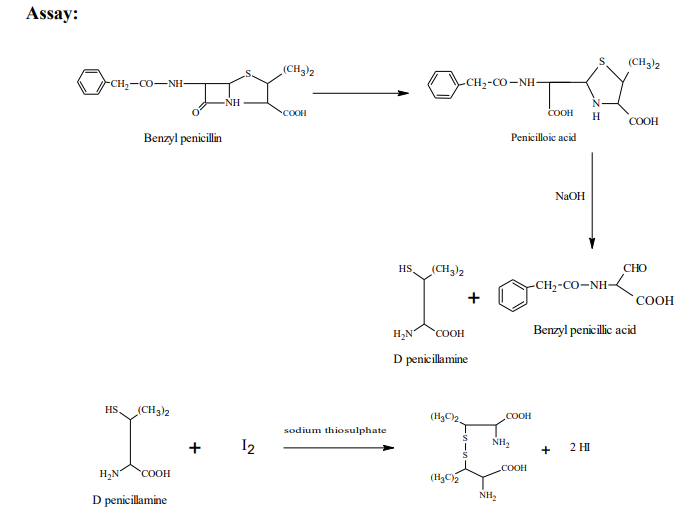
Benzylpenicillin is assayed by the iodometric titration method. The titration is in which an equivalent amount of iodine is liberated to form potassium iodide by the sample and the liberated iodine is titrated against standard sodium thiosulphate solution. This type of indirect titration determination of compounds is called iodometric titration. In this titration, benzylpenicillin is first hydrolysed with sodium hydroxide solution converted to corresponding penicilloic acid (dicarboxylic acid). Then penicilloic acid is further treated with a mineral acid to form D-Penicillamine and benzyl penicillic acid. An obtained D-penicillamine is further oxidized quantitatively iodine to give disulphide, excess of iodine is back titrated with 0.02M sodium thiosulphate, an equivalent amount of liberated iodine can be measured by titration with sodium thiosulphate using starch as an indicator, which is added near the endpoint as it get hydrolysed by hydrochloric acid and iodine gets trapped in the matrix of starch. Due to this, there is no continuous liberation of iodine. An endpoint is blue to apple green.
Reaction
Procedure
Preparation of 0.02N Sodium thiosulphate
0.02N sodium thiosulphate (4.564 gm of sodium thiosulphate and 250 mg of sodium carbonate) dissolved in 100 ml of water then makeup to 1000ml with water.
Standardization of 0.02N sodium thiosulphate
Dissolved accurately weighed 0.2g of potassium bromate in 250ml of water taken in a conical flask. From this take 50 ml of the solution, add 2g of potassium iodide, 3ml of 2M HCl and titrate with sodium thiosulphate solution using starch as an indicator until the blue colour is discharged. Each ml of 0.01N sodium thiosulphate= 0.002784g of KBr.
Assay of Benzyl penicillin
Weighed accurately about 0.1gm of the sodium salt of benzylpenicillin taken in a stoppered flask, dissolved in 10ml of water and dilute to 100ml. 10ml of the solution was transferred into an iodine flask, 5ml of 1N sodium hydroxide was added, allowed to stand for 20 minutes. Then freshly prepared buffer solution, 5ml of 1N hydrochloric acid and 25ml of excess of 0.02N iodine solution was added to the stoppered flask and kept aside for 20 minutes in a dark place. Excess iodine is titrated with 0.02N sodium thiosulphate using freshly prepared starch solution as an indicator. The endpoint is the discolouration of blue colour. To another 10ml of the initial solution add 20ml of the buffer solution, allowed to stand for 20 minutes in the dark place and titrate with the same. The difference between the two titrations represents the volume of 0.02N iodine equivalent to the total amount of penicillin present in the given sample of benzylpenicillin.
Report
The molarity of 0.01M sodium thiosulphate = __________________ The percentage purity of given Benzyl penicillin tablet was found to be = __________________
To determine the percentage purity of a given sample of Chlorpheniramine malate.
Principle
Chlorpheniramine maleate has chemically known as 3-(4-chlorophenyl) N, N- Dimethyl-3-(2-pyridyl) propylamine hydrogen maleate is an antihistamine H1 receptor antagonist. Mineral acid salts of weak nitrogen bases hydrolyse so extensively in the aqueous or hydro-alcoholic solution that is possible to titrate the liberated acid with a strong mineral base. Titration of the maleate salt of the drug in the water against the sodium hydroxide leads to the formation of water turbidity as the titration proceeds. To prevent this precipitation, alcohol has been used. Since alcohol is basic with respect to water as a solvent, dissolved bases react less strongly alkaline, their salts react more strongly acid, and the endpoints of the titrations are greatly sharpened, here an aqueous solution of Chlorpheniramine maleate was titrated with aqueous NaOH, the turbidity was formed with the appearance of pink as the endpoint.
Reaction
Procedure
Preparation of 0.01M Sodium hydroxide
Weighed accurately about 0.4gm of Sodium hydroxide pellet in a clean 1000ml standard flask then completely dissolved with 100ml distilled water, and makeup to 1000 ml with distilled water.
Standardisation of 0.01M sodium hydroxide
Weighed accurately about 0.5gm of potassium hydrogen phthalate and transferred it into a 1000ml conical flask. Then add 75ml of distilled water to dissolve and titrated with 0.01M sodium hydroxide solution using 0.1ml phenolphthalein as an indicator. The end point is the appearance of permanent pale pink colour. Each ml of 0.01M Sodium hydroxide= 0.002042g of C8H5KO4
Assay of Chlorpheniramine maleate
Twenty tablets were weighed and grind into a fine powder. An amount of power equivalent to 200mg of chlorpheniramine maleate was weighed accurately into a 100ml standard flask, 70ml of neutral alcohol was added and shaken for about 20 min. Then, the volume was made up to mark with neutral alcohol, mixed well and filtered using Whatman No 42 filter paper. The first 10 ml portion of the filtrate was discarded. An aliquot of the drug solution containing 2.0-20.0 mg of chlorpheniramine maleate was measured accurately and transferred into a clean 100 ml conical flask and the total volume was brought to 10 ml with a neutral alcohol. Then 2 drops of 0.5% phenolphthalein indicator were added and the solution was titrated with standard 0.01M Sodium hydroxide solution until a permanent pink colour was obtained. Each ml of 0.01M Sodium hydroxide= 0.002042g of C8H5KO4.
Report
The molarity of 0.01M Sodium hydroxide = ___________________ The percentage purity of given Chlorpheniramine maleate tablet was found to be = ____________________
To determine the percentage purity of a given sample of the tablet.
Principle
Dapsone is a diamino diphenyl sulphone. It is assayed by direct diazotization titration. The free primary amino group present in dapsone is diazotized by nitrous acid and hydrochloric acid to form an arene diazonium compound. The endpoint can be determined by using an external indicator i.e. starch iodide paper, during titration with sodium nitrite an aromatic primary amine is diazotized. After the endpoint, the drug solution containing a slight excess of nitrite comes in contact with starch iodide paper. It oxidizes iodide into iodine which gives blue colour with starch indicating the endpoint.
Reaction
Procedure
Preparation of 0.1M Sodium nitrite solution
7.5g of sodium nitrite was dissolved insufficient water to be produced 1000ml.
Standardisation of 0.1M Sodium nitrite
0.3g of sulphanilic acid was dissolved in 50ml of 2M hydrochloric acid, 3g of potassium bromide was added, cool in ice and titrate with 0.1M sodium nitrite solution using starch iodide paper as an external indicator. Each ml of 0.1M Sodium nitrite= 0.01732g of C6H7NO3S.
Assay of Dapsone tablet
20 tablets were weighed and powdered. Tablet powder equivalent to0.25gm dapsone was weighed and dissolved in a mixture of 15ml of 2M hydrochloric acid. The solution was cooled to about 15oC and carry out sodium nitrite titration using starch iodide paper as an external indicator. The endpoint is the immediate appearance of blue colour. Each ml of 0.1M sodium nitrite= 0.01241g of C12H12N2O2S.
Report
The Molarity of 0.1M sodium nitrite = __________________ The percentage purity of given dapsone tablet was found to be = ________________