Requirements: Fine capillary glass tubes of about 10 mm length, cotton, rectified spirit, lancet, stopwatch.
Procedure:
Capillary tube method: (Wright’s method): Under sterile precautions make a sufficiently deep prick in the finger tip. Note the time when bleeding starts (start the stop watch). Touch the blood drop at the finger tip using one end of the capillary tube kept tilted downwards. The tube gets easily filled by capillary action. After about two minutes start snapping off small lengths of the tube, at intervals of 15 seconds, each time noting whether the fibrin thread is formed between the snapped ends. Note the time (stop the stop watch) when the fibrin thread is first seen.
Discussion: Clotting time is the interval between the moment when bleeding starts and the moment when the fibrin thread is first seen. The normal value is 3to 10 minutes. Bleeding time and clotting time are not the same. Bleeding time depends on the integrity of platelets and vessel walls, whereas clotting time depends on the availability of coagulation factors. In coagulation disorders like haemophilia, clotting time is prolonged but bleeding time remains normal. Clotting time is also prolonged in conditions like vitamin K deficiency, liver diseases,disseminated intravascular coagulation, overdosage of anticoagulants etc.
Modified Lee and White method: Under aseptic precaution, venepuncture is done and one ml. of blood is collected in each 3 small test tubes. Note the time when blood is taken. Keep the test tube in a water bath maintained at 37°c. Tilt the tubes every 30 seconds and see whether the blood is flowing. Repeat this till the tube can be inverted without the blood flowing out. Nore the time. The average value of the results in the 3 test tubes gives the clotting time.
Theory: The time required for complete stopping of blood flow from the punctured blood vessels is called the bleeding time. Normally it is 1-3 minutes for a normal human’s blood. Normal clotting time and bleeding time values differ because bleeding time is the time for stopping bleeding by the formation of fibrin network on the surface of punctured skin; that is it is the surface phenomenon. But the clotting time is the time for clotting the whole blood, collected in the capillary tube; therefore it is a volume phenomenon. For this reason, clotting time is more than the bleeding time, when determining by conventional methods.
Clinical significance: It plays a significant role in: i) to study haemorrhagic disorders. ii) to study the coagulation defects iii)to have an idea about the platelets count of the patient. Bleeding time is prolonged in few disorders like vascular lesions, platelet defect, severe liver disease, uremia and anti-coagulant drug administration.
Requirements: Sterilized needle, filter paper, cotton, spirit, and stopwatch.
Procedure (Duke’s method): The finger of a subject is sterilized with spirit and pricked with a sterilized needle. Time of pricking is noted. Take the stain of the punctured point on a filter paper for 30 seconds and keep taking the stain of blood in 20-second intervals until the bleeding stops. The time of no stain has come is noted properly; it is the bleeding time of the subject.
Precaution: Following precautions should be enforced i) Needle should be sterilized. ii) A fain stain of blood should not be avoided. iii) Time should be noted properly.
Aim: To determine the haemoglobin content in 20µl of the blood sample.
Principle: A hemoprotein composed of globin and heme that gives red blood cells their characteristic colour; functions primarily to transport oxygen from the lungs to the body tissues. The red blood cells are broken down with hydrochloric acid to get the haemoglobin into a solution. The free haemoglobin is exposed for a while to form hemin crystals. The solution is diluted to compare with a standard colour.
Requirements: Hemometer, Single mark pipette, Distilled water, Needle, Spirit, Cotton, HCl.
Procedure:
Take 1/10 HCl in the Hb tube upto the lowest mark ‘2’.
Prick the finger with needle and collect 20µl of blood sample with single mark pipette
Place the Hb tube on the working table for five minutes for the formation of hemin crystals.
Place the Hb tube in the compater/hemometer and add drop by drop of distilled water into it until the colour of the solution in the Hb tube coincides with the glass plates of the compater.
If the colour coincides with the glass plates of the compater, observe the reading in the Hb tube. The percentage of Hb can be calculated from the reading.
Evaluation: Hb content in grams X 100 / 14.5
Normal Values:
Male: 14 to 18grams
Females: 13 to 14grams
Children: 10 to 13grams
Result: The hemoglobin content present in 20µl of blood sample is _____________________.
Why drugs are not given in their original pure state?
Give some examples of Solid Dosage Form.
What do you know about “Dusting Powder”?
What are the main ingredients of dentifrices?
Why pills are outdated preparations?
Why is it necessary to use sterilized talc and kaolin in preparing of dusting powder?
Give five examples of Monophasic Liquid Dosage Form.
Why glycerin is used as a base in throat paint?
Give a list of preparations that falls under biphasic liquid dosage form.
Name the emulsifying agents used in the preparation of o/w and w/o emulsion.
Why are additives needed in preparations of different dosage form.
Why is emulsifying agent required in preparing in different dosage form?
Name some of the modern dosage forms.
Write the importance of Dosage Form?
Name the preparations cover under bulk powders meant for external use?
Write in brief about Dusting Powders?
Describe briefly about the solid dosage forms.
How are effervescent granules prepared?
Define Syrup and Why syrup is preferred?
How will you distinguish o/w emulsion and w/o emulsion.
What precaution should be taken while using Eye drops.
What are the qualities of an ideal suspension?
What are the advantages and disadvantages of pills?
Mention the qualities of an ideal ointment base.
Give importance of erythrocytes in new drug delivery system.
Write the application of liposomal drugs?
Define Pro drugs and what are the application of Pro drugs.
Why is soft paraffin not used in ophthalmic ointments.
How will you classify different dosage forms? Write the importance of different dosage forms.
Define Solid Dosage Forms. How will you classify different dosage forms. Write in brief about dentifrices and effervescent granules.
What are monophasic liquid dosage forms? Write in details about syrups and elixirs.
What are emulsion? State the different types of emulsion and how will you distinguish them.
What are ointments? Classify different ointment bases used in the preparations of ointment. Describe briefly each base.
What are the preparations that cover under biphasic liquid dosage form? How will you distinguish between suspension and emulsion.
Define creams ? How will differ creams from ointments? Write in brief about creams.
Prescription
Define the term Prescription.
Define the term Superscription.
What does the term subscription mean?
What is the importance of Latin language in Prescription writing.
What is the importance of date in prescription.
What does the term Inscription means.
What are the advantages and disadvantages of prescribing the drugs by it propitiatory name?
Write the importance of writing age in Prescription.
Write the importance of modern methods of writing prescription.
Name the various sources of errors in Prescription.
Define the term Prescription. Describe in brief about the different parts of a prescription.
Discuss the various sources of errors while dispensing a prescription. How these errors are rectified.
Discuss the procedure which should be followed by a Pharmacist while handling the prescription for compounding and dispensing.
Discuss the various precautions which should be taken by a Pharmacist while dispensing a prescription.
Posology
Define the term Posology.
What does the term official doses mean.
Define the term Synergism.
What is meant by the term Tolerance.
What does the term accumulation means.
Why the quantity of drug which is given by IV Route smaller than the Oral Route.
What is Dillings formula.
Write the clerks formula.
Write the Youngs formula.
define the term additive effects.
Name the various factors that influence the dose of a drug.
Explain the term tachyphylaxis.
What is the duty of a pharmacist in case the medicine prescribes is overdose.
Give the name of the various factors which influences the dose of a drug in animal.
Name the drugs which should be avoided to be given to lactating mother.
Discuss the various factors which affects the dose of a medicine.
Describe the various methods which are used in calculating the dose of a drug in small children.
Explain the different factors which influences the dose of a drug in animal.
Write short note on the followings
Accumulation
Synergism
Idiosyncrasy
Tolerance
Tachyphylaxis
Additive effects
Pharmaceutical Calculations
Give the metric equivalence of:
2drachm
10 fl. ounce
1pint
4 drachm
1tumberful
1minim
5grains
1 quart
1pound
1tblspn
Calculate the following
4 oz of a 1 in 2000 solutions
6 oz of a 1 in 40 solutions
8 oz of a 1 in 800 solutions
1 pint of a 0.9% NaCl solutions
1 pint of a 1 in 80 solution of HgCl2
Solid Dosage Form
Define the following terms:
Unit Dosage Form
Powder
Tablet Triturates
Cachets
Pill
Lozenge
pastille
capsule
Name the bulk powders that are used externally.
what is the approximate capacity in mg of a capsule having number 000, 00, 0, 1, 2, 3,4,5 ?
Mention the advantages and disadvantages of powder.
Write briefly about dusting powder?
What are the advantages of effervescent granules?
Write the advantages and disadvantages of cachets.
Write briefly about geometric dilution.
Mention the difficulties which are faced while using the insufflator.
Write briefly about hard gelatin capsules.
Describe about the soft gelatin capsules. Differentiate between hard gelatin capsules and soft gelatin capsules.
Discuss the essential requirements for a good pill.
Write in brief about the different methods of filling powders in hard gelatin capsules.
Describe the preparation of moulded lozenges.
Define the term Powders? Write the advantages and disadvantages of powder as unit dosage form.
Discuss different methods of mixing powders.
Discuss in brief about effervescent granules. Give the method of preparation of effervescent granules.
Classify different type of Powders. Discuss about the various dusting powders which are meant for external use.
Define Pill. Discuss about the methods of preparation of pills.
Explain the term lozenges and briefly describe about the compounding and dispensing of moulded lozenges.
Define a hard gelatin capsule? How are the capsules dispense in Pharmacy.
Define Pastille and discuss briefly about the preparation of pastille.
Write short note on:
Dusting Powders
Soft Gelatin Capsules
Dentifrices
Effervescent granules
Geometric dilution
coating of pills
cachets
tablet triturates
lozenges
pastilles
compound powders
Hard gelatin capsules
How will you dispense the following:
powders containing potent drugs
powders containing efflorescent powder
powders containing volatile substances
powders containing hygroscopic and deliquescent substances
Monophasic Liquid Dosage Form
Define the term monophasic liquid dosage form
What does the term mixture means
Define the term drought
Give three examples of monophasic liquid dosage form meant for internal use.
What should be the pH of nasal drops.
Write the storage conditions of mixtures.
Give five examples of monophasic liquid dosage form meant for external use.
Why is glycerin being use a base in throat paint?
Why are gaggles dispensed in concentrated form?
Why are nasal drops made isotonic?
Write the main aim of using nasal spray?
Write the uses of douches.
Explain the various adjunts use in the formulation of mixtures.
Classify different type of mixtures.
Differentiate syrup and elixirs.
Write the difference between lotion and liniment.
What are mixtures? Describe different type of mixtures. Describe in brief about the method of dispensing the mixtures containing:
Indiffusible solid
Precipitate forming liquids
What are syrups. How are they different from elixirs and linctuses. Describe the different methods of preparation of syrups.
Discuss the general method of dispensing of
mixture containing indiffusible solids.
mixture containing precipitate forming liquids
mixture containing diffusible solids
What are mixtures?Classify different types of mixtures. Discuss in brief about the different vehicles and adjuncts used in the formulation of mixtures.
Also Queries Solved: pharmaceutics 1 important question,pharmaceutics 1 important questions 2020,pharmaceutics important questions,pharmaceutics 1 important questions,pharmaceutics important question 2021,d pharm pharmaceutics important question,most important question of pharmaceutics,pharmaceutics 1 sem important questions
Aim: To determine the alcohol content of asava and arista.
Requirements:
Digital weighing balance
Beaker
Measuring Cylinder
Distillation flask
Separating funnel
Heating metal
Water bath
Specific gravity bottle
Water
Procedure: Measure 25 ml of formulation by measuring cylinder and transfer to distillation flak having capacity of 500 ml. Wash the measuring cylinder with 150 ml of water and add it to the flask. Add some porcelain pieces to the flask and distilled them. Collect about 90 ml of distillate from this take 25 ml of distillate and dilute it to 100 ml with water and with the help of a specific gravity bottle determine the specific gravity of liquid at 25°C. Follow the alcohol content table with specific gravity and determine the V/V alcohol content in the sample.
Calculate the % alcohol content by using the multiplication factor.
Determine the Specific Gravity: A tube of known weight (W) was filled first with essential oil and then with water and the respective weight w1 and w2 was determined. Then, the specific gravity was calculated using the following formula:
d = (w1-w)/(w2-w)
Relative Density with Percent Ethanol Content:
Relative density at 25oC
Percent ethanol content w/w at 15.56°C
Per cent ethanol content v/v at 15.56°C
0.8158
90
93.3
0.8146
90.5
93.6
0.8131
91
94
0.8118
91.5
94.3
0.8104
92
94.7
0.8090
92.5
95
0.8076
93
95.4
0.8062
93.5
95.8
0.8048
94
96.1
0.8034
94.5
96.5
0.8020
95
96.8
0.8006
95.5
97.1
0.7992
96
97.5
0.7977
96.5
97.8
0.7962
97
98.1
0.7957
97.5
98.4
0.7932
98
98.8
0.7917
98.5
99.1
0.7902
99
99.4
0.7886
99.5
99.7
0.7871
100
100
Report: Alcohol content of Asava and Arista was found to be __________________.
From this post Evaluation of Excipients of Natural origin, we will learn differently chemical tests to identify Tragacanth, Acacia, Starch or Iodine and Honey
Chemical test for Tragacanth
Aim: To identify the chemical characters of a given excipient.
Requirements: Hydrochloric acid, Sodium hydroxide solution, Fehling’s solution, Barium chloride solution, Lead acetate, Ruthenium red Iodine Caustic potash
Biological Source: A dried exudation obtained from the stems and branches of Astragalus gummifer and other Asiatic species of Astragalus. Family: Leguminosae
Description:
Colour: white to slight yellow color
Odour: odourless
Taste: micilaginous taste
Shape: The gum seeps from the plant in twisted ribbons or flakes that can be powdered.
Solubility: 1 gm of the sample in 50 ml of water swells to foma smooth, stiff, opalescent mucilage; insoluble in ethanol and does not swell in 60% (w/v) aqueous ethanol.
Chemical Constituents: Tragacanthin (water soluble part), Bassorin (water insoluble part)
To 4 ml of 0.5% w/v solution, add 0.5 ml of hydrochloric acid and heat for 30 minutes on a water bath Divide the liquid into two parts.
To one part, add 1.5 ml of sodium hydroxide solution and Fehling’s solution, warm on water bath: red precipitate is produced.
To the second part, add barium chloride solution (10%): No precipitate is obtained (distinction fromagar)
To a 0.5% w/v solution of the gum, add 20% w/v solution of lead acetate: A voluminousflocculent precipitate is obtained (distinction from acacia).
Mount a small quantity of powder in ruthenium red and examine microscopically. Particles do not acquire pink colour (distinction from Indian tragacanth).
To 0.1 g of powder, add N/50 Iodine: The mixture acquires an olive green colour (distinction fromacacia and agar).
Powder is warmed with 5% aqueous caustic potash Canary yellow colour will obtain Indian tragacanthIt is obtained from SterculiaurensRoxburgh; (Fam Sterculiaceae). It is insoluble in alkali. It has acetous (acetic acid like) odour and starch is absent. It gives brownish colour when boiled with aqueous KOH. It is stained pink by solution of Ruthenium red.
Report: From the above morphological characters and chemical tests the given excipient is identified as Tragacanth
Chemical test for Acacia
Aim: To identify the chemical characters of given excipient acacia.
Biological Source: Indian gum is the dried gummy exudation obtained from the stems and branches of Acacia Arabica Family: Leguminosae
Description:
Colour: white to slight yellow color
Odour: Odourless
Taste: Bland and mucilaginous taste
Shape: Tears are mostly spheroidal or ovoid in shape with approx. diameter of 2.5-3.0 cm
Solubility: soluble in water, insoluble in alcohol.
Chemical Constituents: Gum Arabic consists almost entirely of glycosidal acid named Arabic acid, combined with potassium, magnesium and calcium By hydrolysis Arabic acid yields 1 molecule of l-sharmose, 2 molecules of D-galactose and 3 molecules of l-arabinose and an aldobionic acid. It also contains diastase and an oxidase enzyme.
Uses: Demulcent, emollient, thickening agent, emulsifying agent, binding agent also used to form coacervates for microencapsulation of drug.
Procedures:
Dissolve about 0.25 gm of the coarsely powdered drug in 5 ml of distilled water by shaking in the cold Add 0.5 ml of hydrogen peroxide and 0.5 ml of benzidine solution, shake and allow to stand for few minutes; a deep blue colour or greenish-blue colour is formed due to the presence of oxidase enzyme.
A 10% aqueous solution of acacia fails to produce any precipitate with dilute solution of lead acetate (a clear distinction from Agar and Tragacanth); it does not give any colour changewith Iodine solution (a marked distinction from starch and dextrin); and it never produces a bluish black colour with FeCl3 solution (an apparent distinction from tannins).
Hydrolysis of an aqueous solution of acacia with dilute HCl yields reducing sugars whose presence are ascertained by boiling with Fehling’s solution to give a brick-red precipitate of cuprous oxide.
Report: From the above morphological characters and chemical tests the given excipient is identified as Acacia.
Chemical test for starch
Aim: To identify the chemical characters of the given excipient.
Biological Source: Starch consist of polysaccharide granules obtained from the grains of maize Zea mays L. or of rice Oryza sativa L or of wheat Triticum sativum L. Family: Gramine or from the tubers of the potato Solanum tuberosum L. Family: Solanaceae
Description:
Colour: white (Rice and maize starch), cream(wheat), slight yellow (potato)
Odour: Odourless
Test: mucilaginous taste
Shape: Fine powder or irregular, angular masses
Solubility: It is sparingly soluble in cold water and mostly soluble in hot water after cooling it forms gel.
Chemical constituents: Amylose, Amylopectin
Uses: Dusting powder, Pharmaceutical aid, protective and demulcent, Tablet disintegrating agent and diluents.
Chemical Test for Starch or Iodine: Amylose in starch is responsible for the formation of deep blue colour in the presence of iodine. The iodine molecule slips inside of the amylose coil. Iodine – KI Reagent: Iodine is not very soluble in water, therefore the iodine reagent is made by dissolving iodine in water in the presence of potassium iodide. This makes a linear triiodide ion complex with is soluble that slips into the coil of the starch causing an intense blue-black colour.
Report: From the above morphological characters and chemical tests the given excipient is identified as starch.
Chemical test for Honey
Aim: To identify the chemical characters of the given excipient.
Biological Sources: Honey is the saccharine liquid prepared from the nectar of the flowers by the hive-bee Apis mellifera, Apis dorsata and bees of other species of Apis. Family: Apidae
Description:
Colour: slight yellow to brown yellow
Odour: pleasant
Taste: Sweet
Solubility: soluble in water and insoluble in alcohol
Chemical Constituents: Glucose 35% (+3%), fructose 45%(+5%), sucrose 2-3% and water (14-20%). Dextrin, maltose, gum traces of succinic acid, acetic acid, volatile oil, amino acid, protein, coloring matters etc.
Uses: Demulcent, nutritive, mild laxative. It is used as an important component of linctuses and cough mixture, sweetening agent, antiseptic and bactericidal. Used as a vehicle in ayurvedic and unani preparations.
Chemical Tests:
Test
Observation
Inference
Fiehe’s Test: Take about 3ml of honey + 2ml of ether and shake thoroughly and allow the 2 layers to separate and evaporate to dryness. The upper etherial layer is separated and put in a china dish and evaporate, to the residue add 1% resorcinol and HCl.
Transient pink colour
Permanent Red colour
Pure honey
Adultered honey (added sugar)
Molisch’s Test: Honey is treated with alpha Naphthol and concentrated sulphuric acid.
Purple colour
Presence of carbohydrates
Reducing Sugar Test: Heat honey to add a drop of mixture of Fehling’s solution A & B
The brick red colour of cuprous oxide
Presence of monosaccharide
Report: From the above morphological characters and chemical tests the given excipient is identified as Honey.
Aim: To prepare and evaluate 10gm of Turmeric – Aloe Vera Gel Herbal Cream.
Requirements: For Preparation of 10gm of Herbal Creams
White beeswax – 5gm
Liquid paraffin- 7ml
Borax – 2gm
Water- 5ml
Perfume – 2 drops
Curcumin (Turmeric) – 200mg
Aloe Vera gel – 1gm
Methyl paraben-0.02gm
Ethyl alcohol – 2ml (Q.S to dissolve curcumin)
NOTE: Curcumin content is 3.14% by dry weight basis.
Principle: Creams are viscous semi-solid emulsions that are meant for external application They usually contain a water-soluble base so that it can easily be removed from the skin. When applied to the skin, creams leave no visible evidence of their presence on the skin. Creams consist of medicaments dissolved or suspended in water removable or emollient bases. Creams are of two types.
Aqueous creams (O/W)
Oily creams (W/O)
Therefore, combining immiscible compounds is possible by mechanical agitation or heat.
Procedure: Melted the beeswax with mineral oil by heating on a water bath at the temperature of 70°C. Here, curcumin is not soluble in water. So it was mixed with a minimum quantity of ethyl alcohol. This was added to the borax water mixture and heated to the same temperature. Both the temperature was attained at a temperature of 70°C added the aqueous phase with rapid constant stirring until cool. Filtered it into a container and labelled it.
Evaluation Parameters of Turmeric Herbal Formulations:
Determination of pH: 1gm of prepared tooth paste and add 9ml of freshly boiled and cooled water. Stir well and make a suspension, pH was determined by using pH meter.
Spreadability Test: About 1gm of sample was weighed and placed at the center of the glass plate and another glass plate was placed over it carefully above the glass plate 100 gm weight was placed up on upper slide so that the formulation between two slides was pressed uniformly to form a thin layer, the weight was removed and the excess of formulation adhering to the slides was scrapped off. One of the slides was fixed on which the formulation was placed, the time in which upper slide moves over the lower plate was taken as measure of spreadability. Spreadability is calculated by using the following formula.
Spreadability = mXl/t Where, m=weight on the slide, l= length move on the slide and t= time taken.
Skin Irritation Test: The ointment was placed on patches and covered with gauze for 4 hrs, skin was observed for any signs of redness, inflammation and weeping of scabs.
Ration TPENETest: 0.5gm of ointment was rubbed over definite area of skin for a given time then unabsorbed was collected from skin and weighed.
Uses: Uses of Herbal Turmeric Cream is given below:
Anti wrinkle properties of herbal ingredients
Anti ageing properties
Skin protective properties
Report: Curcumin-Aloe Vera gel skin Herbal Cream prepared and evaluated.
Apparatus Required: RBE, Condenser, Beaker, Funnel, and Glass rod
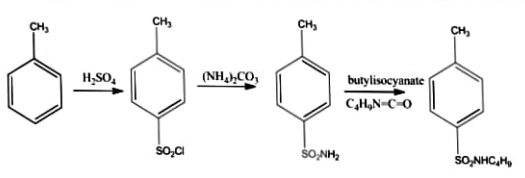
Principles: Tolbutamide, NP-methylbenezenesuphonyl)-N-butyl urea is an oral hyperglycemic agent used for the treatment of non-insulin-dependent diabetes mellitus (NIDDM). It is structurally similar to acetohexamide, chlorpropamide, and tolazamide and belongs to the sulphonylurea class of insulin secretagogues which act by stimulating the beta cells of the pancreas to release insulin. Sulphonylureas increase both basal insulin secretion and metal stimulated insulin release
Synthesis of Tolbutamide
Procedure:
Procedure for synthesis of p-toluenesulphonyl chloride from toluene
Heat 130 gm of pure toluene and 450 gm conc. sulphuric acid in a cast- iron pot fitted with suitable agitator. Add few crystals of iodine and allow the temperature to rise 100c.
The sulphonation is complete in about 6 hrs, transfer the reaction mixture in a large beaker diluted with water. Add lime water gradually neutralize the excess acid.
Filter out the calcium sulfate and any ferric hydroxide and wash with hot water.
Add sodium carbonate to the filtrate until just alkaline to phenolphthalein and remove the calcium carbonate by filtration. Evaporate the filtrate almost to dryness, when sodium salt of o toluene Sulphonyl and p-toluene sulphonyl acids separate out. When the reaction is complete add cold water. The p-toluene sulphonyl chloride separates as a solid and recrystallizes with alcohol. The O-toluene sulphonyl chloride is an oily liquid and is separated from the filtrate by means of a separating funnel.
Procedure for synthesis of p-toluene sulphonamide
Thoroughly mix 5 grams of p-1oluene sulphonyl chloride and 10 grams of ammonium carbonate by grinding in a mortar until a fine powder is obtained.
Heat the mixture on a water bath with continuous stirring to convert sulphonyl chloride into sulphonamide. Crystallize the product from hot water. Filter off as colourless crystals.
Procedure for the synthesis of ethyl p-toluene sulphonyl carbamate
Mix the corresponding sulphonamide 49 grams with ethyl chloroformate 42 grams and anhydrous potassium carbonate 3 grams in dry acetone 400 ml and reflux for 20 hours. Remove acetone by distillation under reduced pressure and keep the solution overnight and then add in water 250 ml. Neutralize with acetic acid. Filter the solid product and wash with distilled water and recrystallize with alcohol.
Procedure for synthesis of tolbutamide
Dissolve the specified carbamate derivative in hot toluene 30 ml. Add butylamine slowly and reflux for 4 hours. Filter and dry it.
Report: Tolbutamide was prepared and submitted.
Uses: Tolbutamide is used together with diet and exercise to improve blood sugar control in adults with type 2 diabetes mellitus. Tolbutamide is not for treating type I diabetes.
Chemicals Required: Distill Water, Formaldehyde, Conc: NH3 or NH4OH, Diethyl ether and ethyl alcohol.
Apparatus Required: Rotary Vapouriser, Thermometer, Litmus Paper, Measuring Cylinder, Reflux Condenser, Round Bottom Flask, Beaker, Buchner Funnel, Water Bath, Vaccum Desiccator and Glass Rod.
Principle: Hexamine is a heterocyclic organic compound that is also known as Methenamine or Hexamethylenetetramine or Urotropin. Hexamine use as an anti-infective agent and used to treat Urinary Tract Infections. Hexamethylenetetramine is prepared by the condensation of formaldehyde and ammonia
Synthesis of Hexamine
Procedure: The procedure of preparing hexamine is given below:
Place of 10ml of 37% formaldehyde and 9ml of ammonia into a round bottom flask.
Evaporate the solution on a Rotavapor.
During evaporation, a white residue (urotropin) is formed.
Add another portion of Ammonia 14ml to dissolve the solid.
Once more place the flask onto a Rotavapor and evaporate the solvent. Repeat the solvent. Repeat that step once more with an additional portion of ammonia(14ml).
After evaporation add 15ml of anhydrous ethanol and dissolve the solid by heating under reflux.
Filter the hot mixture on the Bichner Funnel.
Add 10ml diethyl ethar to the filtrate and cool down.
Filter the precipitated urotropin wash it with anhydrous ethanol drain well and then dry on air.
Report: Hexamine was prepared and submitted.
Uses of Hexamine: Uses of Hexamine is discussed below:
Hexamine dominantly used in the preparation of powdery and liquid preparation of phenolic resin moulding compounds.
Hexamine is also used as a food preservatives.
Hexamine is also use against concomitant odour and excessive sweating.
Are you going to attend an Interview for Quality Assurance in the Pharma industry? Then you are in right place in this post, we have shared some commonly asked Interview Question Answers for Quality Assurance in Pharma Industry. In the end, we also have shared some tips which will help you to clear the Interview. Now read the whole post and Best of luck with the interview.
Interview Question Answers for Quality Assurance in Pharma Industry – 2021
Basic Questions That Asked in Every Interview
No matter for which post you are going to sit in the Interview but there are some common basic questions that are being asked in every interview you should practice these questions first. Some basic questions are given below.
Once you answered the basic questions the Interviewer will then start asking you questions related to the subject. They want to check how much knowledge you have for the subject. If you don’t know answer of any question that you are asked simple told them that you don’t know the answer but don’t give any wrong answer.
Q. What do you mean by SOP?
Ans: SOP means Standard Operating Procedure (SOP) which is a certein type of document that describe procedures in step by step.
Q. What do you mean by Quality Assurance?
Ans: Quality Assurance is a set of activities for ensuring quality in the processes by which products are being developed.
Q. What is the aim of Quality Assurance in Pharma Industry?
Ans: Quality Assurance aims to prevent defects with a focus on the process used to make the product. It is a proactive quality process.
Q. What is the difference between Quality Assurance and Quality Control?
Ans:
Parameter
QA
QC
Aim
QA aims to prevent defects in the process.
QC aims to prevent defects in the final product.
Action
QA is a managerial tool.
QC is a corrective tool.
Goal
The goal of QA is to improve development and test processes.
The goal of QC is to identify defects after a product is developed.
Whose responsibility is it
Everyone on the team present in developing the products
A specific team that test the product for defects
Example
Verification is an example of QA.
Validation is an example of QC.
Q. What is cGMP?
Ans: The full form of cGMP is Current Good Manufacturing Practices. It is enforced by FDA and it provides system that assure proper design, monitoring, and control of manufacturing processes and facilities.
Q. What is the differnce between cGMP and GMP?
Ans: cGMP refers to Current Good Manufacturing Practices where GMP only refers to Good Manufacturing Practices.
Good Manufacturing Practice (GMP) is a system for ensuring that products are consistently produced and controlled according to quality standards. It is designed to minimize the risks involved in any pharmaceutical production that cannot be eliminated through testing the final product.
But in cGMP these guidelines ensure the right designs, monitoring procedures and the required control of the manufacturing processes and the facilities used.
Q. Describe the methods used for Calibration and Validation.
Q.Why always water for pharmaceutical use is kept in close loop in continuous circulation?
Q. Why water that is used in Pharmaceuticals should be free from heavy metals,cations, anions and other impurities ?
Q. Which countries comes under climatic zone IVb ?
Ans: Countries that come under climate zone IVb are Brazil,Cuba,China,Brunei,Cambodia,Indonesia,Malaysia,Myanmar,Philippines.
Q. What is purpose of doing stress testing in stability studies?
Conclusion
Nobody can give you the exact questions that will be asked to you in the Interview except some basic questions that are being asked in every Interview. The best thing you can do before attending an Interview get as much knowledge of the company and the designation for which you are goint to attend the Interview.
Download our android app click here. You can find the latest versions of many pdf books, the latest collection of university question papers, MCQ Quiz test, and update via notifications. Our app is completely ad-free and no need to register in our app to use it. Why waiting to download it now from Google Play Store.
Queries Also Solved In This Post: pharma interview questions and answers, interview questions and answers, tricky QA interview questions, QC interview questions and answers in pharma, quality assurance interview questions in pharma, interview questions, interview question answer for quality assurance in pharma, QA interview questions, pharmaceutical interview questions, QA interview questions and answers, QA interview questions and answers in pharma, IPA interview questions in pharma, QC interview questions and answers, interview tips